The Harvard-Smithsonian Center for Astrophysics offers the public access to a network of small robotically-controlled telescopes. The following fieldwork assignment invites you to work with images collected from that telescope to replicate Galileo’s discovery that the planet Jupiter has a number of moons orbiting it.
Here’s what Jupiter looks like through one of the Harvard-Smithsonian telescopes, with a setting that shows the planet against a field of stars. Some of those stars are actually moons—but which ones?

Jupiter and its moons, 7:30am on 9/25/22
Jupiter’s moons differ from stars in two respects. First, they aren’t bright pointlike sources of light. When the telescope is adjusted to exclude pointlike sources of light, this is the result:
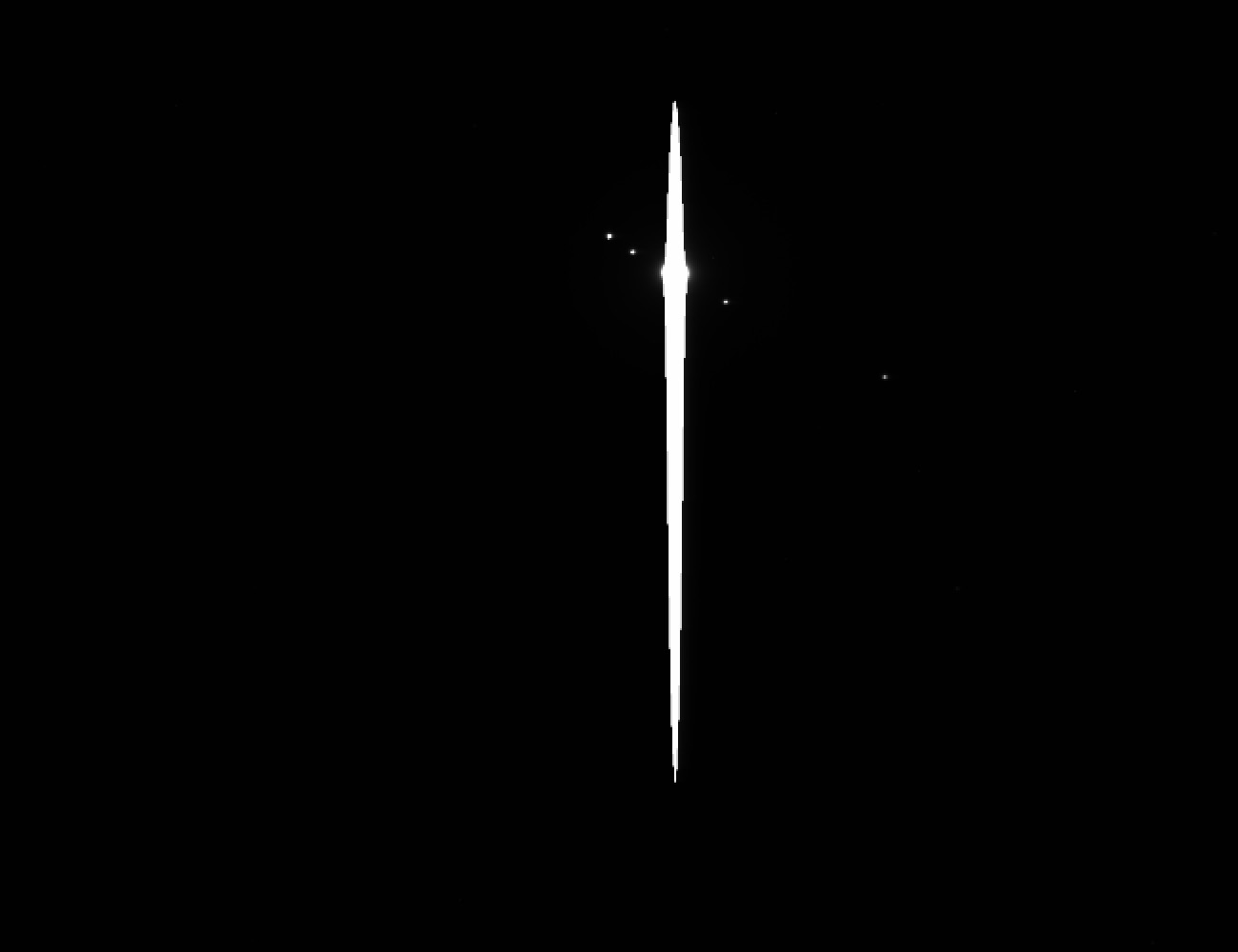
Jupiter and its moons, 7:34am on 9/25/22, filter set to highlight the moons
This telescope adjustment will help us a lot in our study, but what really sets Jupiter’s moons apart from background stars is that they MOVE. That’s the property that got Galileo excited, and it’s the one which we will focus on in this fieldwork. To detect the moons’ movement, we need to compare images taken over a sequence of hours or days. I’ve assembled a bunch of images for you (download here), but I’m leaving it up to you to decide which subset of these images to focus on.
Due week 7: preliminary
From the collection of 15 images linked above, select 3-4 that tell a story of the moons’ motion relative to Jupiter. Consider whether you get better results comparing hour-by-hour or day-by-day photos. Consider also how you might present this data, visually, to maximum effect? Post your reflection in the comments below.
Due week 9: final version
Report: drawing exclusively on the image set linked above, what can you conclude about the moons revolving around Jupiter? How many distinct moons do you see? Taking into account the timestamp of each image, are some of the moons orbiting faster than others? To be clear, your goal is NOT to get the “right” answer to any of these questions, but rather to get the best answer(s) you can based on the evidence available to you.
Your report should draw from at least three of the images, and should present them visually so as to highlight the moons’ motion. Image processing: to better isolate this motion, you will likely need to manipulate the images so that Jupiter is stationary. Note that all these images all have the same magnification and angle, so all you need to do here is shift the images up, down, right or left to bring Jupiter into the same position from one image to the next. Clear visual presentation of this data will be one factor considered in the grade for this assignment.
Options for your write-up:
- You can assume the persona of Galileo, one of his assistants, or a contemporary rival, writing in the early 1600s as one of the first people to see Jupiter’s moons.
- Alternatively, you can write from a modern perspective, evaluating your results by comparison to modern data (Wikipedia).
Either way, match your language to the occasion. Your writeup should detail the procedure you followed in processing the data, and should conclude by meditating on how your results might be improved upon.
Turn your report in by emailing it as a .pdf to Prof Henebry.
Show/Hide due Week 7
Show/Hide due Week 9
Due Week 7
⤹Click the reply button just below.
For the photos, I decided on 2 photos from 10/3/2022 and 10/4/2022, with the 2 photos from different days having similar, if not the same, timestamps. For the timestamps, I chose 5h00m and 6h00m. In my opinion, I feel like the day-to-day images make it much easier to see the cyclical difference. When looking at 10/3/2022 at 5h00m and 6h00m, there is a slight shift to the left, and we can see all 4 moons surrounding Jupiter. I would present 3 sets of photos. I would do a day-by-day comparison, I would do an hour-to-hour comparison, and then I would do a comparison of all 4 photos in time order. These 3 different presentations would allow the viewer to understand the speed, direction, and number of moons that Jupiter has and how they move. This helps show the progression of the orbit and would give the maximum effect as it covers two different days with two consistent time stamps (making it the easiest to compare them since time is the hour is held constant).
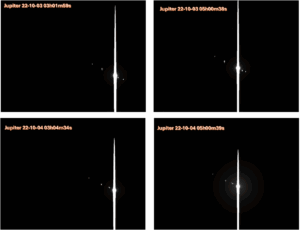
I chose the 4 photos of:
10-03 at 03:01:59
10-03 at 05:00:38
10-04 at 03:04:34
10-04 at 05:00:39
In my opinion, it is important to compare both hour-by-hour and day-by-day. Without hour-by-hour, you cannot track the trajectory of the celestial objects in the sky and therefore cannot tell that the group of moons moves with Jupiter. Therefore, without this key insight we cannot draw valid conclusions. We need to also compare day-by-day to ensure the constant nature of this orbit path. By ensuring that the path is very similar the next day, we know that we can track the orbit of these objects around Jupiter as a pattern and a celestially predictable path. Therefore, I chose these 4 photos specifically to ensure I can compare both by hour and by day to see the path of motion across the sky and the constant nature across days.
Visually, I would present this data in two pairs. The first pair would be vertically above the second pair, where pair 1 is the photos from October 3rd and the second pair is from October 4th, where the photos taken at the same hour are vertical to each other. This way, we can track the consistency across days and the horizontal path across the sky to draw the best conclusion.
The image Jupiter 22-10-02 06h01m32s.GIF is interesting because you can see three moons on the left side and one on the right side. The next image, Jupiter 22-10-03 06h49m47s.GIF, is also fascinating because there are now two moons on the left side of Jupiter and two on the right. Finally, Jupiter 22-10-04 06h01m36s.GIF is notable because all four of Jupiter’s moons appear on the left side from our perspective.
These three images together show how the moons move around the planet. I think comparing them day by day gives better results, since in just a few hours the moons only shift slightly. Over the course of several days, though, you can see significant changes, with the moons ending up on completely different sides of Jupiter.
If I were to present this data visually, I would focus on just a few striking images where the moons are in drastically different positions, like the ones I chose. This approach highlights the motion of the moons to maximum effect. The other images still show their movement, but the differences are smaller and less visually dramatic, so they don’t have the same “wow” factor.
I chose image 22-10-02 (4am) , 22-10-02 (6am), 22-10-03 (4am), and 22-10-04 (3am). I think these photos best show the two moons closer to Jupiter as they orbit around Jupiter. I think the best results come from comparing day by day because it shows the moons’ motion over time in a more dramatic way.
To present these images, I would put them side by side. I would ask viewers the same question we were asked for this assignment, allowing them to have the experience of observing the orbiting as well. I would be sure to add the timestamps as well, to provide more insight into the moon’s orbital speed.
I selected pictures taken at 04:00, 05:00, 06:00 and 06:48 on October 4. These images demonstrate how Jupiter’s moons shift in position with respect to the planet over the course of a few hours. The moons, which are little bright dots around Jupiter, fluctuate considerably from frame to frame, while Jupiter itself appears overexposed due to its brightness. The inner moons’ faster orbital motion and more pronounced positional changes than the outer ones are demonstrated by this hour-by-hour comparison. The moons’ constant linear alignment reveals their orbits along Jupiter’s equatorial plane as seen from Earth. I would think of making an animated sequence or a composite image to visually represent this data and highlight the motion’s evolution. By using these techniques, it would be simpler to understand and more interesting to watch the orbital movement. The moons’ dynamic movement around Jupiter can be better understood by utilizing hourly images, which I felt to give a sharper and more immediate feeling of motion than day-by-day comparisons.
I selected four telescope images of Jupiter taken on October 4, 2022, at 3:04 AM, 4:00 AM, 5:00 AM, and 6:01 AM. I chose these because they show Jupiter’s moons over roughly three hours, making their orbital movement easier to notice. In the earliest image (3:04 AM), the moons appear fairly evenly spaced on one side of Jupiter. By 4:00 AM and 5:00 AM, one of the outer moons shifts slightly outward while another moves closer in. By the final image at 6:01 AM, the spacing between them has clearly changed, showing visible motion relative to Jupiter.
What stood out most to me is how steady Jupiter remains at the center, while the smaller points of light move around it. This sequence captures exactly what Galileo must have seen — evidence that these tiny “stars” were actually orbiting another planet. To highlight this clearly, I would arrange the images in chronological order so the moons’ shifting positions can be followed from left to right. Watching the slow change across just a few hours really brings Galileo’s discovery to life.
– When looking at celestial objects such as moons and stars and comparing images, it is important to have an idea of what you are trying to look for beforehand. I believe getting an idea of the movement trajectory, and shifts in positioning is a good start. So I believe it’s important to pick images that are atleast a day apart to get a good idea of the trajectory and the consistency in the movement pattern. It could help to look at the same hour, but a day apart. It could also be helpful to look at images from a few consecutive hours, this will allow to get an idea of the direction of the trajectory of the object. All the images in the folder, sort of depict the moon to be in the middle around 3:00-4:00hrs, and then shift leftwards as the hours go on. I picked the following images: – Jupiter 22-10-02 04h01m42s.GIF – Jupiter 22-10-02 06h01m32s.GIF – Jupiter 22-10-04 04h00m41s.GIF – Jupiter 22-10-04 06h01m36s.GIF
These images clearly show the movement of Jupiter’s moon, and this movement trajectory seems to be pretty consistent over the two different days of observation. The first two images are from the same day, starting at 4am and going up to 6am. The next two images follow the same time, and pattern, except they are two days after the first two observations. It is extremely visible through these images that Jupiter’s moon starts around the middle around 4:00 and then moves leftwards each hour. It is important to acknowledge that there could be fluctuations in the movement of the telescope. The last 2 images also show the moon moving leftwards, but it starts and ends at a different position(could be cause of a different telescope angle/positioing), though it follows the same leftward trajectory. I would present these all these images on the same screen, have the 4am from the different days above and below each other and then have the rest follow. I would also have the dates and timestamps printed on each image to show the directions, speed, magnitude of movement. I think it could also be helpful to quickly flip(at increments of an hour on the same day, and then show the audience the same hour-increments but from a different day) through these images to show the movement, and also show the difference in the start and end positions depending on the hour and the day.
In my opinion it is more important to analyze the moons movements by day by day images rather than hour by hour, as the hour by hour may be too subtle. Many of the moons complete significant portions of their orbits in the day changes so it shows more easily noticeable changes and offers us a more dynamic story of the movement of the moons.
I chose these three images: Jupiter 22-10-02 06h01m32s, Jupiter 22-10-03 06h01m35s, Jupiter 22-10-04 06h01m36s. The reason I chose these three images was because each were exactly one day apart, which shows the differences in orbits and movements after two 24 hour periods. From these three images it is clear that the moons move in a diagonal patterns relative to Jupiter. We can see that one of the moons starts on the left side of Jupiter in the first day, moving to the right side of Jupiter in a diagonal fashion sitting to the bottom right of the planet in the second image, and coming back to the left in the third image. Another one of the moons follows a similar patters, starting on the left and circulating the planet and resting on the opposite side by the third day. The two farthest moons to the left do not move to the right side of the planet, but rather their distance from the moon fluctuates implying that they go from being more horizontally oriented to the moon to being further behind it which could signify longer orbit periods. The strength of the light also changes throughout the days showing a change in distance from the telescope. I think in order to display this data so that it makes the most visual sense, we would need to analyze hourly and daily data to follow the exact trajectory of the moons. I would consider putting degree lines and arrows pointing to the trajectory within the images.
I chose the photos:
10-02 04h01m42s
10-02 05h00m38s
10-04 04h00m41s
10-04 05h00m39s
This selection effectively shows the movement of the moons by hour and by day. You are able to see the 2 inner moons move considerably more than the outer moons because of their faster movement. When presenting these 2 pairs of images, I would align Jupiter in a constant position so viewers can notice the movements more clearly. This would make it easier to realize the moons are moving horizontally on Jupiter’s equatorial plane. I would also structure the photos as a moving gif with timestamps on each pic.
In most cases, photos spaced out closer to day-by-day appear to be more useful than photos spaced out hour-by-hour, because you can see broader changes. I chose these photos (Jupiter 22-10-02 06h01m32s, Jupiter 22-10-03 03h01m59s, Jupiter 22-10-03 06h01m35s, Jupiter 22-10-04 03h04m34s) because they show specific changes in the positions of Galileo’s Moons relative to Jupiter, changes which reveal a complex system as viewed from the Earth. By comparing Jupiter 22-10-02 06h01m32s vs Jupiter 22-10-03 03h01m59s, we can clearly see one of the moons moving from the left to the right of Jupiter: it went from 3 moons to the left with 1 moon on the right to 2 moons to the left with 2 moons to the right of Jupiter. These are probably the two most important photos for me – the moons are clearly in constant motion relative to Jupiter. Next, we can compare these two photos to Jupiter 22-10-03 06h01m35s, which is useful since it shows what appears to be a relative maximum move to the right of Jupiter for the rightmost Galilean Moon. Also, when you compare the 1st two chosen photos to this one, you can see that the moons are likely moving at different speeds: the distance between the middle two moons in this series is most obvious, showing a growing gap between the two middle moons during this set of 3 photos. Finally, it’s useful to add in Jupiter 22-10-04 03h04m34s, which shows all 4 moons to the left of Jupiter (in less than 24 hours time)! From these 4 photos, we can say that the moons appear to be moving from left to right of Jupiter, then suddenly swings back from right to left.
To make these photos easier to follow, I would try to create a time series of the photos, and have them all centered on Jupiter at a constant position in the middle, to show more clearly the changes in motion of the moons. I might also add a visual aid to emphasize the tilted axis that the moons are moving on, and check if the axis is changing over time relative to Earth. I might also consider adding distance indicators from each Moon to Jupiter to show how their distance from Jupiter in the different photos is changing over time (the leftmost and rightmost moons are most useful here).
I realized I have replied to the wrong thread so I will just paste what I wrote earlier yesterday: For this I chose to the images Jupiter 22-10-03 03h01m59s, Jupiter 22-10-03 05h00m38s, Jupiter 22-10-04 03h04m34s, and Jupiter 22-10-04 05h00m39s. The idea is to show both hour-to-hour comparison and day-to-day story. The hour-to-hour comparison shows the partial orbital motion of the inner moons. Within the same night but different hours, we can see Jupiter shifts slightly in the frame but the moons also showed small changes relative to Jupiter’s position, proving the motion Galileo discovered: the moons orbiting Jupiter, not Earth. When I compared images taken at the same hour on consecutive days, Jupiter remained in nearly the same spot, yet the moons had clearly moved to different positions around it. This demonstrates that while Jupiter’s position relative to the background sky changes very slowly, its moons complete noticeable portions of their orbits.
–
From the collection, I selected 4 images of Jupiter taken on October 3 and 4, 2022: 22-10-03 06h01m35s, 22-10-03 06h49m47s, 22-10-04 06h01m36s, and 22-10-04 06h48m49s. By comparing these, I could see how some of the small bright points near Jupiter (or its moons) changed position. From my observation, it seemed that on 10/3, the 4 moons were divided on both sides of Jupiter, with two on each side. By 10/4, however, all 4 moons shifted to the left side of Jupiter. This shows how the moons orbit at different speeds and distances, causing their positions to noticeably change even within a day. When it comes to movements each day, the shift is quite subtle, with Jupiter seemed to move slightly upward or to the left. Therefore, I think that comparing day-by-day photos produced more visible results than hour-by-hour comparisons, revealing the orbital movement of the moons around Jupiter more clearly. To present the data effectively, I would place the 4 images in chronological order side by side or in a “flipbook” style (so it can “animate” the simulating motion). Overall, studying these differences made me realize how ahead Galileo findings were during his time. I also found it interesting how even with modern telescopes, we can replicate a discovery from over 400 years ago using the same basic idea, which is tracking movement across time.
I chose the photos:
Jupiter 22-10-02 04h01m42s
Jupiter 22-10-03 04h00m43s
Jupiter 22-10-04 04h00m41s
These three photos are each taken a day apart at the same time of day showing the moons’ motion 24 hours after the previous photo. When comparing these photos I saw that the inner moons moved much more than the outer moons. I can assume that this is because of the shorter distance the inner planets have to travel compared to the outer moons. Also in these pictures, Jupiter remains stationary throughout because the moons are rotating around it. Creating a short video/GIF to show the movement of the moons across the 3 days would be an effective way to present this data.
I choseJupiter 22-10-02 04h01m42s, Jupiter 22-10-03 04h00m43s, and Jupiter 22-10-04 04h00m41s
Observing them, I saw that the inner moons moved much faster than the moons that are farther from Jupiter. I believe this is the case because of the concept of gravity and relativity where the closer and object is to jupiter the faster it moves and the smaller its orbit is. I think though that it would be easier to see the movement if it was put into a slideshow of some sort or if all of the photos were places sequentially to look at the relative movement of everything in the picture. But overall it is very fun to look and examine these pictures.
I selected these three photos:
– Jupiter 22-10-02 06h01m32s
– Jupiter 22-10-03 06h01m35s
– Jupiter 22-10-04 06h01m36s.
Selecting day-by-day photos over three consecutive days at the same hour has been helpful in observing the moon’s motion and speed relative to Jupiter. The moons’ positions shift noticeably across the days, showing the changing positions that appear minimally in hour-by-hour photos. In day-by-day photos, the shifts in alignment and distance from Jupiter become more distince, allowing for more accurate visual analysis of each moon’s motion and relative speed. For example, I see two moons on the left side, out of four total, that are in the relatively same spot in the three pictures, though their brightnesses change. This tells me that these two moons move at relatively similar speeds. To better present the data to maximize effect, I would compile more pictures, each taken twenty-four hours apart, then arrange them chronologically. Additionally, overlaying them would help trace orbital paths and relative speeds. Therefore, interpreting day-by-day photographs would help in determining the general paths (which may see benefit from analyzing hour-by-hour photographs as well) and speeds for Jupiter’s moons.
The 4 images I chose were:
10-04 03:04:34
10-02 06:01:32
10-02 04:01:42
10-03 06:49:47
I chose these photos in this order to demonstrate that at least one of the moons runs in an orbit closely parallel to ours. In 10-02 4:01:42, one of the four previous moons cannot be seen. This means that the orbit of that moon must be close to ours or is slightly askew and gets shadowed by the larger Jupiter. Unfortunately, these images aren’t presented in chronological order, yet it is a day-by-day comparison. The choice of order was purely aesthetic, the first image has four moons to the left of Jupiter, second image has three with one to the left, and the fourth has two on each side. The reason is to observe the motion relative to Jupiter rather than observe and try to measure the speed through distance traveled between photos.
To capture the moons’ motion relative to Jupiter I decided to choose 4 images. 3 being images around a day apart (“Jupiter 22-10-02 05h00m38s”, “Jupiter 22-10-03 05h00m38s”, “Jupiter 22-10-04 05h00m39s”) to show a around even interval of motion over time, and the last image being “Jupiter 22-10-04 06h48m49s” to show shorter-term motion within the same night. This sequence of images clearly shows the orbits of each of the moons around the planet, with small positional changes in hour-to-hour images, but a more dramatic change in the day-to-day ones. Visually, the data could be presented as an animation of these images over each other, aligning Jupiter at the center and plotting each moon’s change with a trail. This would maximize the sense of the moons’ movements, and be the most stimulating to most viewers.
I chose the photographs Jupiter 22-10-03 06h01m35s, Jupiter 22-10-03 06h49m47s, and Jupiter 22-10-04 03h04m34s. I selected these three because the first two are only 48 minutes apart, with the third being hours about 20 hours later than the second. I think it is important to note how little the photographs changed in those 48 minutes and how drastically the moons shifted with the third. For me, it seems obvious that going day by day would lead to wrong conclusion, so hour by hour should be the approach. To present this data, we can look through the hour by hour pictures and note when we see a visual change by checking back with the first photo as we iterate through the others. This will prevent us from not marking changes because each photo may look similar to its predecessor.
I chose the photos taken between October 2nd and October 4th. I believe the four images during this time to be of particular significance. It does entirely seem that the relative positions of Jupiter’s moon shift considerably. Even though the stars in the background remain the same, the little light points move closer and farther. Unlike the stars, these are satellites, which are in motion and do not seem to remain in a relatively fixed position like the stars are.
This could be traced back to Galileo’s astronomy in which he stated that not every celestial body revolves around the earth.
From the photos above, I selected the photos from 10/2 at 04h01m, 10/3 at 04h00m, and 10/4 at 04h00m. I feel like by using day-to-day comparisons, it is easier to tell how the moons orbited around Jupiter. In these pictures, Jupiter stays fixed in the center while its moons move noticeably along linear paths on either side, showing the orbital motion that the moons take. I feel like presenting these motions as a short animation or stop animation could be cool to show off this motion, and could make the motion more obvious to viewers, too.
I chose four images to demonstrate both hour-by-hour and day-by-day orbital motion:
22-10-02 04h01m42s
22-10-02 06h01m32s
22-10-03 06h01m35s
22-10-04 06h01m36s
The first two images from October 2nd show a two-hour interval where one of the moons emerges from behind Jupiter, revealing the three-dimensional nature of their orbits around the planet. This hour-by-hour comparison captures the moment when a moon that was previously obscured by Jupiter becomes visible, demonstrating that these objects orbit in different planes relative to our viewing angle.
For the day-by-day comparison, I selected three consecutive images taken at 6am across October 2nd, 3rd, and 4th. These clearly show how the two inner moons shift positions relative to Jupiter over 24-hour periods, moving noticeably from one side to the other while the outer moons remain more stable in their positions.
It’s pretty amazing that we can recreate that same “aha moment” centuries later with these telescope images, watching those little points shift around Jupiter and understanding exactly what made his discovery so groundbreaking.
I selected the images from 10-03 04h00m43s, 10-03 06h01m35s, 10-04 04h00m41s, and 10-04 06h01m36s. This set captures both short-term and day-to-day motion of Jupiter’s moons. In the hour-by-hour comparison, the inner moons noticeably shift positions, while the outer ones remain steadier. Across the two nights, the overall arrangement of the moons changes more dramatically, showing their continuous orbit around Jupiter. For presentation, I would keep Jupiter fixed in the same spot and display the sequence side by side or as a looping animation with timestamps to make the moons’ motion stand out clearly.
Due Week 9
⤹Click the reply button just below.
I select images: 22-10-02 04h01m42s, 22-10-02 06h01m32s, 22-10-03 04h00m43s, and 22-10-03 06h49m47s. These images beautifully capture the motion of Jupiter’s moons over a small period in the same day and larger periods throughout different days, where the bright object in the middle of the image is Jupiter and the small light points are its moons. Examining those pictures together, the movement of the moons orbiting around Jupiter is clearly seen. Comparing the photos hour by hour, we can emphasize the moon’s gradual motion; while day-by-day observation highlights the larger arcs of the moon’s orbits, and we can actually observe the displacement movement of Jupiter itself. If I’m recording the data, to visualize this most effectively, I would present the images sequentially or record live, best aligning Jupiter at the center so that we can trace the smooth, circular paths of the movement of the moons.
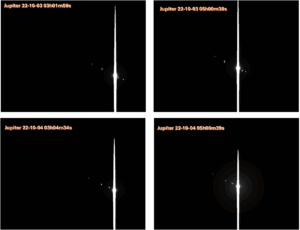
For this I chose to the images Jupiter 22-10-03 03h01m59s, Jupiter 22-10-03 05h00m38s, Jupiter 22-10-04 03h04m34s, and Jupiter 22-10-04 05h00m39s. The idea is to show both hour-to-hour comparison and day-to-day story. The hour-to-hour comparison shows the partial orbital motion of the inner moons. Within the same night but different hours, we can see Jupiter shifts slightly in the frame but the moons also showed small changes relative to Jupiter’s position, proving the motion Galileo discovered: the moons orbiting Jupiter, not Earth. When I compared images taken at the same hour on consecutive days, Jupiter remained in nearly the same spot, yet the moons had clearly moved to different positions around it. This demonstrates that while Jupiter’s position relative to the background sky changes very slowly, its moons complete noticeable portions of their orbits.
–
After reviewing the full collection of images, I chose four frames—from October 2, 04:01, October 2, 06:01, October 3, 05:00, and October 4, 06:01. This day-by-day comparison best reveals the motion of Jupiter’s moons relative to the planet itself. Hour-by-hour changes are subtle, but across 24-hour intervals, the moons clearly shift from one side of Jupiter to the other. Visually, I would present the data by aligning Jupiter at the center of each frame and marking the moons with colored circles or labels. Placing the images side by side or creating a time-lapse GIF would make their orbital motion obvious. The fixed background stars remain still, while the moons move noticeably—proving that they are not distant stars but objects orbiting Jupiter, just as Galileo realized more than 400 years ago.
I chose the first 3 pictures, dated October 2nd 2022 at 4am, 5am and 6am. I believe that by comparing the picturses by hour, we capture the movement of the moons rather than the movement of Jupiter. In the first image taken at 4am, we clearly see three of Jupiter’s brightest moons and the diagonal they draw between them. If you look closely at Jupiters left, you see a point that shines somewhat brighter, this being a moon that’s blocked at that time by Jupiter. This can be seen more clearly in the picture an hour later, being able to discern the four distinct moons still maintaining the diagonal between them. Lastly, the last picture fully shows the four moons and their positioning related to Jupiter. I believe that depending on what you are trying to understand, comparing day or hour is better. For example, if comparing the moon position, pictures by hour are ideal. However, when comparing Jupiter’s position, then day by day is better. Furthermore, in order to present this data better, you could use a Timelapse or a Zoetrope to put the images together and rotate them quickly to give the sensation of movement.
I chose 4 of the 22-10-03 photos. By focusing on the hour-by-hour photos, you can see the movement of the moons instead of the movement of Jupiter you would get if you were to focus on the day-by-day photos. For maximum effect in presentation, it’s mostly dependent on what you want to focus on. You can present a series of consecutive hourly images to show movement throughout the night, or a series of daily images to show movement throughout a longer time period. I think to maximize effect, you can overlay the images over a certain time period and label the time/date of each celestial object to capture the movement across the night sky
I chose three images taken on October 3rd. One at 4:01, 5:00, and at 6:0. As presented by these photos, we can see the moons movement clearly. In the first image, there are only three visible moons. This can be explained by the fact that the last moon is hiding behind Jupiter itself. In the next hour at 5:00, we can see that the hiding moon shifts to the left and the four moons are now visible. This illustration suggest why it might be better to observe the movement of the moons on an hour by hour basis. By observing the movement on a day by day basis, we would be able to observe the movement of Jupiter itself but here we are trying to observe the moons position RELATIVE to Jupiter. To ensure that we are encapsulating the movement of the moons orbiting around Jupiter, I believe that it would be effective to record the movement of them on a time lapse so that the viewer can see it’s clear movement in a span of an hour.
From October 3 at 03h01m59s, 05h00m38s, 06h49m47s, and October 4 at 06h48m49s. In the first image, the moons are spread out on both sides of Jupiter, and as the hours go by, they shift positions until they almost switch sides completely. You can see the moons’ motion and how they orbit in a steady rhythm. I would show the photos in a time-lapse or lined up in order so it’s easy to follow the movement. I like how something that looks still at first suddenly comes alive when you compare the pictures over time. It makes the planet system feel real and active instead of just distant dots in space.
Solid article! Thinking about bankroll management & variance is key in tournaments. Quick, easy deposits like those at philucky slot can help you stay in the action longer, minimizing tilt! Focusing on solid fundamentals is always a win.
Gonna try out winpkrgame. Sounds like a good time. Let the games begin. Join and play today winpkrgame!
Wow, interesting article! It’s cool how mobile gaming is evolving – quick access is key. I saw bingoplus app game offers a super fast install & registration – sounds convenient for a quick bingo fix! 👍
Struggling to fachai net đăng nhập? This link helped me out. No more login issues! Saved me a ton of frustration: fachai net đăng nhập
Excellent fieldwork assignment! This hands-on approach to replicating Galileo’s discovery beautifully demonstrates how observational astronomy works. Students learning to distinguish moons from stars through movement patterns mirrors the scientific method’s essence. Modern openclaw clawdbot platforms could enhance such projects with automated image analysis tools.
Fascinating project! Just as precision telescopes reveal Jupiter’s hidden moons, modern platforms like champion zone download apk enhance our entertainment experiences through advanced technology. Your systematic approach to image selection shows real scientific thinking!
Lottery odds are fascinating – truly a study in probability! Seeing platforms like GBet embrace modern payment options (like GCash) & security is smart. Check out the gbet app download apk for a seamless experience. Hoping for those life-changing jackpots! 😉