Due Sep 15
Fixed Stars and Wanderers
Stars, planets, comets, novas, and shooting stars as observed by the ancients. Greek astronomy under the influence of Plato: Eudoxus, Aristotle. Linking Ancient Egyptian sun-worship and the design of the Giza pyramid complex.
Astronomy Reading
- Openstax Astronomy (pdf | online), Chapters 2 and 4.1-4.4
- Magli, Archaeoastronomy, Ch 8: selections.
Fieldwork Prep
Read the instructions for the Autumnal Equinox fieldwork, linked at right. Then, as a trial run for that experiment, photograph the setting sun with your cellphone camera. Upload the resulting image to the fieldwork page, along with a 1¶ reflection: is this a good location for carrying out the full experiment?
Arts Assignment
Examine one of the following texts or artifacts from the perspective of an archaeologist. What does it suggest about the cosmology of the culture that created it? — beliefs about the heavens and their relationship to people and places on Earth? Use the first ¶ to give a rich description of the text or artifact, including the place and date of creation. Use the second ¶ to push toward a fuller understanding of the culture that produced this piece. To be clear: I’m less interested in your ability to look up correct answers than in your analytical insights based on what you see and how you imagine it being used. (For example, you might consider whether the object served to maintain or to challenge existing social norms and hierarchies.) If you quote or paraphrase, provide an MLA source citation.
- Christ’s Nativity, as described in Matthew 1:18–2:12 (King James Version)
- The Head of Alexander the Great as the Sun God Helios (MFA Boston)
- Relief of Akhenaten as a Sphinx (MFA Boston)
- Iranian Sun-Disk Pectoral (MFA Boston)
- The Trundholm Sun Chariot (National Museum of Denmark)
Post your response below by clicking “Reply” under the appropriate heading. (Note: for best results, include two ¶ breaks between your ¶s.)
Christ’s Nativity
The gospel of Matthew is a book of the New Testament in the Bible, and is traditionally noted to be written by Jesus Christ’s disciple, Matthew, with the date of writing placed sometime between 75 and 100 A.D. (Davies and Allison 128). The story of Christ’s nativity is found in Matthew 1:18-2:12, documenting the circumstances of Jesus’ birth and the pilgrimage of the magi. Between Matthew 1:18-25, the text accounts the circumstances of Jesus’ birth from Joseph’s perspective, being visited by an angel to affirm him of the legitimacy of Mary’s pregnancy despite being a virgin. From Matthew 2:1-12, the text’s narrative shifts to that of the magi. The magi have wandered in the direction of a specific star rising in the east in search of the “king of the Jews” (NRSV), and were directed to Bethlehem by King Herod. After visiting Jesus and giving Him gifts in Bethlehem, the magi are warned in a dream to go a different route and avoid Herod.
The culture surrounding the gospel of Matthew in general is of the Romans, who were a prominent force in the New Testament and are explicitly mentioned later in the story of Jesus’ resurrection. The Roman senate’s history was in instituting divine honors toward its leaders, specifically Julius Caesar and his lineage (Hornblower et al. 688); the birth of Jesus from otherwise ordinary people was written as a direct contrast to the divine lineage of Roman ideology. This indicates that the ancient Hebrew likely took offense to claims of divinity, especially those in a direct lineage, which did not match the divinity of God and the prophecies of a singular claim of divinity in the Old Testament. This is evidenced in Matthew by the genealogy of Jesus; its tracing back to Abraham and David (two figures prominent in their association with God in the Old Testament) serve as justification for Jesus’ divinity that would have swayed the ancient Hebrew audience. The magi play a critical role in how the ancient culture viewed astronomy. In many translations, the magi are translated as “wise men” (as in the KJV translation), indicating that the study of the cosmos was deemed important and a symbol of being knowledgeable. The magi’s origin of “from the east” further indicates the importance of their findings and the finding in Matthew in particular; as much of the Bible is centered around the Mediterranean and Egypt, the fact that magi travelled from even further to visit Israel likely means they not only perceived their charting and prediction as accurate, but significant enough to justify what could be numerous weeks of travel to Bethlehem. The reason for their travel also indicates a level of astrology; they used the movement of the stars to deduce a specific event, that being the location of the king of the Jews. The magi in Matthew are described in the NRSVue translation of the magi as “astrologers,” existing as a middle ground between scientific observations and religious faith. Their presence in the Bible indicates that the ancient Hebrew did believe in a level of astrological meaning in their understanding of the cosmos, in as much as it was aligned with their religious practices.
Works Cited
Davies, William David, and Dale C. Allison. A Critical and Exegetical Commentary on the Gospel According to Saint Matthew: Introduction and commentary on Matthew I-VII. T. & T. Clark, 1988. Anna’s Archive. Accessed 15 September 2026.
Hornblower, Simon, et al., editors. The Oxford Companion to Classical Civilization. Oxford University Press, 2014. Google Books, https://www.google.com/books/e.....frontcover. Accessed 15 September 2026.
edit: The magi in Matthew are described in the NRSVue translation of the magi as “astrologers,”
to
The magi in Matthew are similarly described in the NRSVue translation as “astrologers,”
If I dug this text up like a fragment of papyrus from a jar in the Egyptian desert, here’s what I’d have: a short story written in Greek, probably put together in the 80s CE by a Jewish Christian community somewhere near Antioch, Syria, a city sitting right at the overlap of Roman rule, Greek culture, and Jewish tradition. It wasn’t carved in stone, it was copied by hand on papyrus and passed around small house churches, so making it was really a group effort built on shared belief, not one person’s craft. The story is loaded with sky imagery: a star rising in the east, foreign astrologers reading it as a sign a king was born, and a string of dreams where angels tell people what to do next. None of that is just flavor text. Every bit of it connects things happening on the ground, a birth in a small town, a king losing his mind with paranoia, a family running for the border, straight back to signals coming from the sky.
That tells me these people saw the sky as something that actually gets involved in human politics, not just a backdrop. The star doesn’t just shine, it moves, it points, it stops right over a house, which is basically the same language ancient cultures used when the sky was backing up kings and emperors (think Julius Caesar’s comet). What’s interesting is this community took that same “sky picks the winner” idea and pointed it at a poor baby in a nowhere town, right under a king who only had his job because Rome let him. That’s not just a story about stars, that’s a jab at power. It’s using the sky’s authority to undercut Herod and the whole system holding him up. Then you add the dreams guiding Joseph around, and you get a picture where regular powerless people are getting direct info from heaven that the guy on the throne doesn’t have access to. If I found this with zero context, I’d read it as proof that a group with no power was telling itself heaven had picked their side.
Matthew 1.18-2.12. The Holy Bible: King James Version, Oxford UP, 1998.
Alexander / Helios
The currently displayed bust of Alexander the Great as Helios the sun god is actually a 2 century AD Roman recreation of the 2-3 century BCE Greek bust of the same nature. The Roman took a lot of inspiration from Greek society, so it stands to reason that they would copy the Greek bust as a way to appropriate it into Roman culture. While in the process venerating one of the greatest generals of all time. The holes in the back are said to have once held a bronze crown that would’ve symbolized the unwavering power and majesty of the sun.
The correlation between Alexander the Great and Helios was undoubtably combined together for this bust to illustrate the greatest that was Alexander. For the original Greeks that created the bust it was to honor a famous Greek conqueror and to serve as a sign of pride for the people of Greece. It probably did the same for the Romans who recreated the statue, demonstrating the greatness of the Roman Empire, who had surpassed the Greek civilizations militarily. The Romans probably believed the veneration of Alexander the Great as Helios, shows that great generals are people to be revered and honored in their society.
The pictured sculpture, Head of Alexander the Great or Helios, is a Roman marble sculpture from around the 2nd century A.D. It is believed to be a Roman copy of a larger-than-life depiction of Alexander the Great. His thick, flowing hair, strong features, and upward gaze make him appear powerful and almost god-like. The sculpture also connects Alexander to Helios, the Greek god of the sun. Even though parts of the face are damaged, the size and details of the sculpture show that Alexander was meant to be seen as more than an ordinary ruler.
From an archaeological perspective, this sculpture shows how closely religion and political power were connected. By associating Alexander with Helios and the sun, the artwork connects a human ruler on Earth with the divine world above. Alexander’s military success and reputation made him seem almost superhuman, and these types of images helped strengthen that idea even after his death. It also shows how much gods and religion influenced the way people viewed powerful leaders. The fact that Alexander continued to be represented with god-like features centuries later shows how strongly his image influenced Roman art and ideas about power.
The marble head carved to represent Alexander the Great in the image of Helios was created either in the Roman period of the 2nd century A.D. It is also possible it was carved in the 19th century, though the authenticity has not been fully resolved. The piece was originally carved to be set on a freestanding statue.
The title “Alexander the Great or Helios, the sun god,” suggests that Alexander the Great was viewed with the highest reverence. Roman astronomy and religious belief is largely influenced by its Greek counterpart. Helios, as god of the sun, represents the most important pillar of survival as the sun is essential to the harvesting of crops and the sustenance of life. Comparing Alexander the Great to a god is a testament to his influence on Roman society as a hero of the past. It is likely that he was viewed as a model for military strength and power over society, thus making him comparable to the sun. His comparison to the Helios implies that he was one of the most heroic icons within Roman society
The sculpture Head of Alexander the Great or Helios, the Sun God shows Alexander connected with Helios, the sun god. The MFA says it is Roman and dates it to the 2nd century A.D. or maybe the 19th century. The exact place where it was made is not clearly given, but the provenance is connected with Egypt. It is made of Carrara marble from northwest Italy and is about 48 centimeters high. The head is turned upward and to the left, and the hair looks very thick and strong. The museum also says the head was probably part of a very large statue. To me, the size and the way the head is shown make the figure look powerful and important. I think this sculpture shows that religion and political power were closely connected. Alexander is shown like Helios, so he looks like more than just a normal ruler. Since Helios is the sun god, this image gives Alexander a kind of divine power. I also think this could make people respect him more. If people saw a huge statue of a ruler connected with a god, they might feel that the ruler was above ordinary people. So, to me, this artwork probably supported the social hierarchy and made the ruler’s power seem stronger.
Works Cited
Museum of Fine Arts, Boston. “Head of Alexander the Great or Helios, the Sun God.” Museum of Fine Arts, Boston. Accessed 14 Sept. 2026.
The bust of Alexander the Great, or Helios the Sun God, was a 2nd century A.D. Roman marble creation, now displayed at the MFA. However, it’s also believed that it could be a 19th century creation meant to mimic the Roman style. The bust was meant to be set into a large, nearly full-body statue, displaying the greatness and heroic stature of the ruler. It is carved deliberately with flowing hair and facing upward, as if looking towards the sun, showing the direct comparison to the mighty Greek god, Helios, who was known to be an all-seeing witness and the personification of the Sun (Britannica).
From an archaeological perspective, combining the human leader with the god Helios shows that according to Roman culture, they belied that the heavens directly controlled and justified power on Earth. Meaning that the gods decided who could be in control of a state, and personified themselves in human form. Additionally, their belied extended to the fact that the sun was not only a light in the sky, but rather an all-seeing divine force that kept order on Earth. By creating the resemblance between Alexander the Great and Helios, the creators showed everyday people that their emperor was chosen by the heavens and would watch over them, as a witness and protector, similar to the sun. This thought and creation could have helped maintain the strict social hierarchies and royal authority that could often be found in Roman societies, because obeying their ruler was regarded the same as respecting their gods.
Works cited
Britannica Editors. “Helios.” Encyclopædia Britannica, 15 July 2026, https://www.britannica.com/topic/Helios-Greek-god. Accessed 14 Sept. 2026.
The Head of Alexander the Great or Helios is a Roman marble sculpture from around the 2nd century A.D. and is believed to be a copy of an earlier image of Alexander the Great. His thick hair, strong facial features, and upward gaze make him look powerful and almost god-like. Even though parts of the face are damaged, the sculpture still gives the impression that Alexander was meant to seem larger than life. The connection to Helios, the Greek god of the sun, also adds to this idea and makes him seem more than just a normal ruler.
What stands out to me is how the sculpture connects religion with political power. Alexander was already known for his military success, but showing him with god-like qualities made his image even stronger. In my opinion, this shows how art could be used to shape the way people viewed important leaders. The fact that Romans were still creating images of Alexander centuries after his death also shows how lasting his reputation was and how much influence he had on later ideas of power and leadership.
This artifact, called Head of Alexander the Great or Helios, the Sun God, is a Roman marble sculpture that may have been created during the 2nd century A.D. The head is much larger than life size and was originally part of an almost colossal statue, showing that the figure was meant to appear powerful and important. His head turns upward toward the sky, while his thick hair, calm expression, and idealized appearance make him seem more divine than an ordinary person.
From an archaeologist’s perspective, the sculpture suggests that Roman culture could connect powerful human rulers with the heavens and the gods. Representing Alexander as Helios, the god of the sun, seems to blur the line between human and divine power. The statue’s enormous size and upward gaze may have reinforced this connection by encouraging people looking at it to associate political authority on Earth with a greater power in the heavens.
Akhenaten as a Sphinx
The relief was created between 1349 and 1336 B.C. The prominent sphinx carved into its limestone surface clearly connects the work to ancient Egyptian culture. However, the sphinx depicted here differs considerably from the more familiar form of the creature. In traditional representations, the sphinx generally has the body of a lion and the head of a human. In this relief, however, it is also given human arms and hands, allowing it to present offerings to Aten, the sun god.
In my view, the relief served two closely related cultural purposes: to represent a hierophany associated with the sun and to demonstrate the pharaoh’s elevated status and royal authority. The hierophany is most evident in the sphinx’s posture and actions. It extends its human arms toward Aten, with one hand raised in worship and the other extending an offering to the Aten. These gestures suggest that the ancient Egyptians regarded the sun as a manifestation of divine power worthy of reverence and offerings. At the same time, the sphinx represents Pharaoh Akhenaten himself. By adopting the form of a powerful mythical creature that traditionally symbolized kingship, Akhenaten emphasized his superior social position and authority as pharaoh. However, the fact that even the king is shown worshipping and presenting offerings to Aten precisely indicates that the relief’s primary purpose was to express devotion to the sun god. Although Akhenaten held the highest position in Egyptian society, the relief still portrays him as subordinate to Aten’s divine power. From such a perspective, it is obvious to see the divine significance in the ancient Egyptians’ minds.
The Relief of Akhenaten as a Sphinx was created in ancient Egypt during Akhenaten’s reign, around 1353–1336 BCE. It shows the pharaoh (a title given to a king or queen of ancient Egypt) with the body of a lion, absorbing the rays of Aten (the sun disk), whilst also making an offering of sort in return.
The relief suggests that Egyptians saw a strong connection between the heavens and earthly power. By showing Akhenaten receiving Aten’s rays, the artwork presents him as having a special relationship with the divine. This may have helped strengthen his authority while also promoting his new focus on Aten over the beliefs of traditional Egyptian gods who ruled before him.
The Relief of Akhenaten as a Sphinx made of limestone from 1349–1336 B.C. in the New Kingdom of Egypt, flanked a temple doorway. Akhenaten as a sphinx shows his adoration towards Aten, rendered as the Sun disk in the upper left corner. During this Amarna period when it switches to a monotheistic religion of the Sun god Aten from Amun, there are many reflections of this change in the art.
For starters, instead of the typical greywacke, this period was marked with limestone, a much softer stone to symbolize the different ideas of this new religion. Also, in the Sun disk, there is a small cobra, signifying that this is the only supreme diety, which shows the importance and emphasis on the cosmos that Akhenaten (name meaning “Aten is pleased”) pushed. Since Aten is believed to embody both feminine and masculine qualities, Akhenaten was shown by more curvilinear forms as apposed to the rectilinear forms of the past. Everything down to the forms of their bodies is a reflection of the Sun god Aten. The ankhs are shown to be given by the Sun disk to Akhenaten as a sphinx, showing that Aten is giving life to them, giving him importance as the King. Since the sphinx gives offerings, this exchange of giving to the Sun god and the Sun god giving life back, also shows how much the Sun god and the cosmos was a part of their culture.
The Relief of Akhenaten as a Sphinx was created in the New Kingdom of Egypt between 1349-1336 B.C, during the reign of Akhenaten in the 18th dynasty. The medium used was limestone and the depiction of Akhenaten himself as a Sphinx making offerings to his god, the sun disk Aten, is symbolic of his elevated status and the shift to the monotheistic religion devoted to Aten which he introduced.
Looking at the relief, we see the pharaoh’s devotion to Aten, with many offerings being made in exchange for the power or strength provided by the sun’s rays. While the sphinx had always been associated with the sun, and the pharaohs of old believed the sun god Ra governed the seasons, this was a departure from the ways of the old kingdom where the pharaohs considered themselves keepers of the cosmic order and intermediaries between gods and humans. This dramatic religious reform and Akhenaten’s subsequent establishment of a new capital city and pharaoh tomb at Amarna on the east bank of the Nile would certainly have challenged the social norms of the time.
The Relief of Akhenaten as a Sphinx, is an Egyptian artifact estimated to be created during New Kingdom, Dynasty 18, reign of Akhenaten 1349–1336 B.C. It shows Akhenaten, an Egyptian Pharaoh at the time, as a sphinx – a cultural symbol of power while aligning his devotion to the sun god Aten. This block was one of a pair that flanked a temple doorway at Akhenaten, where the king is shown to be making offerings to Aten. Behind, as well as also above him, appear to have cartouches with names of Aten, Akhenaten, and Nefertiti (Museum of Fine Arts, Boston).
The piece of artifact demonstrates the linkage between human civilization and religion, at its finest. The King itself depicted itself as the creature – part man, part sphinx. Additionally,tThe object, though made years beyond our existence, depicts the common social hierarchy and questions that surround our community today. This artifact can be viewed in different ways:
1) The king is shown to be making offerings to suggests that religion and success in wealth and legacy are deeply intertwined – a common cultural aspect that we see in East Asian Cultures
2) The king is depicted as part lion, part man – I’m wondering if this is a metaphor of the inner human nature, specifically how we have put ourselves as predators (like the lion) and top of the animal kingdom
3) Social Hierarchy – even someone, like the king, is devoting themselves to what they believed as a greater power. Nowadays, even in corporate settings, there is always a hierarchy of executives.
All in all, this piece suggests that the culture of Egyptians back then valued loyalty, power, especially towards royalty. The sphinx itself, suggests the idea that even though as humans, we are intelligent and that’s what makes our powerful, alongside with loyalty amongst the kingdoms.
Museum of Fine Arts, Boston. “Relief of Akhenaten as a Sphinx.” Museum of Fine Arts, Boston Collections, https://collections.mfa.org/ob.....s-a-sphinx. Accessed 15 Sept. 2026
–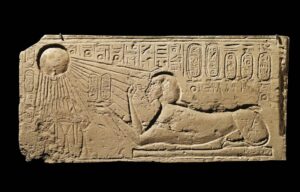
The Relief of Akhenaten as a Sphinx, created in Egypt around 1349–1336 BCE, shows Pharaoh Akhenaten with a human head and the body of a crouching lion, while the Aten, represented as a sun disk, shines rays down toward him. This combination of human, animal, royal, and solar imagery suggests that the culture viewed the pharaoh as a connection between the heavens and Earth. The relief also shows how Akhenaten’s religion focused on the Aten as the source of life. By presenting himself in this powerful supernatural form, Akhenaten reinforced his special relationship with the divine and his authority over society, while also challenging Egypt’s traditional religious traditions (Museum of Fine Arts, Boston).
Sun-Disk Pectoral
I chose the Iranian Sun Disk Pectoral, made in the iron age around 10th or 9th BC. It was found near Eastern Iran, and depicts an 11 pointed star imprinted onto gold. It is not very large, spanning around 9 cm, but it is an attachment to a necklace. According to MFA’s website, the disk was made to commemorate the sun god Shamash, known for being the god of justice.
As this is part of a necklace, I have suspicions that whoever wore this was likely chosen as a very important person, or worn for special occasions. With the sun god ruling over justice, it seems as if a ruler would wear this to exert power over their subjects. Another interpretation could also be a judge or jury wearing the sun disk to “harness” power of the god to make the right moral decisions in fights. There would be a judge responsible for channeling Shamash’s power to condemn the person that they believe is in the wrong.
What does it suggest about the cosmology of the culture that created it? — beliefs about the heavens and their relationship to people and places on Earth? Use the first ¶ to give a rich description of the text or artifact, including the place and date of creation. Use the second ¶ to push toward a fuller understanding of the culture that produced this piece.
The Sun-Disk pectoral is mainly made up of a bigger sun with 11 points and other smaller star-like objects around it. I think this suggests the importance of the sun as a guiding object, similar to the way that it is presented in the center of this disk. I noticed as well there is a little hook at the top, perhaps to be worn or to be hung somewhere. There is 2 circles of some sort of herringbone decorative design around the outter rim of the circle. I noticed that the material is also made out of gold, something that is commonly associated with a symbol of wealth. In the center of the sun-disk pectoral, there is small circular divet in which the sun rays shoot out from.
It’s interesting to see in the description that it is related to “evoking the sun god Shamsah.” In the same way the smaller stars around the major sun are presented in the disk, I think this has a similar implication for the relationship between god and the people around him. As the sun is the center, there is this kind of energy around it where everything is radiating from him similar to the stories of how Gods are typically a sort of figure of light. Since it’s made out of gold, probably someone powerful was wearing this piece of jewelry. As it’s meant to be worn and showed off, it seems like wearing this was a way of connecting yourself to that same sun-power. Almost like saying the importance of the person wearing it comes from the same place the sun’s does.
Trundholm Sun Chariot
The trundholm sun chariot was made in 1400 BC during the bronze age. It depicts a horse dragging a golden sun on a chariot, though the gold has fallen off over the millenia. Found in Zealand during the plowing of a bog, the chariot is deemed to be of Nordic origin. It is meant to illustrate the norse idea that the sun is dragged across the sky every day by a divine horse. The coolest part too is that it’s on wheels, and would have actually moved at the time.
In general, it’s my knowledge that pieces like this were used to continue to push religious ideals onto the people. Similar to icons in the medieval era, having a beautiful, shiny piece of religious media will often keep masses invested in a certain ideal. its ingenuity as well, the beautiful metalwork and the fact that it was on WHEELS is incredible. For the nordic people who hadn’t seen anything rolling probably EVER it must have been an unbelievable sight.
The Trundholm Sun Chariot was made in Denmark around 1400 BCE during the Bronze Age. It is a bronze and gold sculpture of a horse pulling a large sun disk on wheels. The gold side likely represents the sun during the day and the darker side represents night. The wheels suggest that people believed the sun moved across the sky in a regular cycle (National Museum of Denmark). This shows that the culture connected the heavens to life on Earth. The sun may have been believed to control seasons, time, and nature. The chariot may have been used in religious rituals to honor the sun. It is made of valuable materials, so that could also show the power and status of religious leaders or elites.
The Trundholm Sun Chariot was made in around 1400BC. Found in Northwestern Zealand, an island of Denmark, it was made in the Early Bronze Age. As an old sculpture, it showcases a horse pulling the sun behind it. Both the sun and horse are on wheels, this symbolizes its motion. The chariot itself was cast with bronze and a wax clay model that the bronze is poured into. The sun is larger than the horse, plated with gold.
The culture drew heavy importance to the sun and horses themselves. The horse was trusted to bring the sun across this journey, they most likely used horses often for pulling materials and for everyday life. The sun being bigger than the horse suggests that the sun is also important for daily use. The entire sculpture being on wheels suggests that it wasn’t just displayed, but used to show motion. It could have been used to educate students on how they viewed the sun and what it did as they tracked its motion across the sky. It is big enough of a sculpture to use along with storytelling like a prop. I think the sculpture was used to elevate education and storytelling. It isn’t just a display piece, but a moving sculpture with wheels to describe the motion and importance of the sun by relating it to the horses that are seen and being used in daily life.
The Sun Chariot is a statue originating from northwestern Zealand, Denmark, with Nordic origins in the Early Bronze Age (around 1400 BC). The statue displays a flat Sun clad in gold being pulled by a horse on wheels, resembling a common chariot. This artifact was initially discovered in September 1902.
The Sun Chariot displays a belief that the Sun is pulled by members of the Earth; in this case, animals. I see the horse as symbolizing Earth, drawing the Sun as it rotates around it. The wheels reinforce this idea, both mimicking rotation and allowing the Sun to move only if the horse moves with it. I believe the use of gold to cover the Sun also imitates an ethereal glow, attaching a more spiritual and active role to the Sun rather than portraying it as simply a celestial body. I imagine the Sun’s journey as eternal, with the Nordic peoples believing that the horse would continue to draw it across the sky for the rest of time.
The Trundholm Sun Chariot is an artifact from 1400 BCE that was discovered in Zealand, an island in Denmark. On a wheeled base the kinetic sculpture depicts an elegant steed towing a chariot that carries the sun. The majority of the artifact looks to be made of a single metal, potentially bronze as historians date it to Early Bronze Age, but the sun is plated with a much more brilliant material. It’s hard to tell if the horse had more decoration that was lost to time, but intricate embossing on the golden surface of the sun still survives. There are concentric rings, spirals, and radial lines that catch the light and highlight the importance of the sun in this piece. The horse is quite stylised, but not to the point of abstraction. He looks resolutely forward as he pulls the chariot.
The spiral symbols and location of discovery lead historians to belive The Sun Chariot was made by a Nordic artist. The combination of a celestial body and earthly horse in one sculpture suggest that Norse people may have thought of the heavens similarly to our own world. They might think of the sky as a realm of afterlife where humans and deities can interact. The artifact also suggests that Norse people understood the sun rising and setting was cyclical rather than linear. In the excerpt from Archaeoastronomy, Magli said ancient Egyptians believed the sun died every night only to be reborn the next morning. However, this depiction of the sun being a singular object in a moving chariot shows Nordic cultures knew the sun that rose on a day was the same sun as the day prior.
The Trudholm Sun Chariot is a small bronze statue made in the Early Bronze Age, around 1400BC, in Scandinavia. The Sun Chariot gives us insight into the prehistoric religion of the Nordic Bronze Age. It can also help us understand the cultural and religious nordic beliefs about the sun, the heavens, and the underworld. The artifact depicts a divine horse pulling a large sun disk, which represents the the sun, across the heavens during the day and through the darkness of the underworld at night. Priests would use the Sun Chariot to preform their rituals and they used it to demonstrate the passage of the sun through the heavens.
The sun disk is decorated with spirals, which we can use to tell that it is of genuine Nordic craftsmanship because the spiral design was a Nordic specialty of the bronze age. The spirals may also have had a symbolic meaning. The design could very much be inspired by the constant rotation of the sun around the heavens and the underworld. The wheels that the sun disk sits on may symbolize the continuous movement of the sun. This suggests the ancient Scandinavians understood that the sun was not a stationary object, yet one that was in a continuous moving cycle.
The Trundholm Sun Chariot was made during the Early Bronze Age around 1400 BC and was found in 1902 in the former bog Trundholm Mose in northwestern Zealand. It shows a thin horse on four large wheels pulling a round disk, which is also placed on wheels. The ‘disk’ is a sun disk and it is now half golden, faded and covered in spirals and patterns that we can barely see. You can also see some faded patterns on the horse’s head. Some parts of the object are missing now, especially parts of the wheels and the horse’s tail.
I think this shows that the sun was probably very important to the culture that made it. A normal horse obviously could not pull the sun, and the horse is usually way smaller than the sun, so the horse may have been seen as something divine or supernatural. What stood out to me most is that the sun is shown as something that can actually get moved, almost like it is being carried across the sky by the horse. Maybe the culture thought the sun was moved by a horse, by a chariot in the sky, and that’s how they perceived the movements of the sun from it leaving, entering and moving across the sky. So, instead of understanding the sun’s movement the way we do now, they may have explained it through a story of a divine horse carrying it across the sky. Also the wheels also seem important because they make the movement of the sun easier to imagine for them. The fact that the sun is covered in gold and detailed patterns also makes it seem especially powerful or sacred. To me, the object shows how people used things they already knew, or maybe during that time especially, like horses and chariots, to explain something much bigger that they saw happening in the sky every day.
–
The Trundholm Sun Chariot was discovered in Denmark and dates back to around 1400 BCE. The artifact consists of a bronze disk mounted on a wheeled vehicle and pulled by a horse. One side of the disk is covered with gold leaf and decorated with spiral patterns, while the opposite side is darker. It appears small enough to have been carried or displayed during religious ceremonies. The combination of the horse, wheels, and shining disk creates the impression of a journey across the sky.
From an archaeological perspective, the Sun Chariot suggests that Bronze Age Scandinavians viewed the sun as a living force that traveled through the heavens. The horse appears to pull the sun across the sky during the day, while the darker side of the disk may represent its journey through the night. The artifact implies that celestial movements were understood through myths and religious beliefs rather than scientific explanations. It also suggests that the sun played a central role in both religious life and society. Overall, the Sun Chariot reflects a cosmology in which the heavens were active, meaningful, and closely connected to human life on Earth.
I chose the Iranian Sun Disk Pectoral, made in the iron age around 10th or 9th BC. It was found near Eastern Iran, and depicts an 11 pointed star imprinted onto gold. It is not very large, spanning around 9 cm, but it is an attachment to a necklace. According to MFA’s website, the disk was made to commemorate the sun god Shamash, known for being the god of justice.
As this is part of a necklace, I have suspicions that whoever wore this was likely chosen as a very important person, or worn for special occasions. With the sun god ruling over justice, it seems as if a ruler would wear this to exert power over their subjects. Another interpretation could also be a judge or jury wearing the sun disk to “harness” power of the god to make the right moral decisions in fights. There would be a judge responsible for channeling Shamash’s power to condemn the person that they believe is in the wrong.
The Relief of Akhenaten carved limestone block depicting a sphinx, found in sunk relief around 1349–1336 BC at Akhetaten in the new capital Akhenaten built in the middle of the desert, which is modern el-Amarna. The king is shown crouching like a sphinx on a plinth, but instead of lion paws he has human arms raising one in worship and using the other to hold a small basket with the Aten’s names in cartouches. Above him is the Aten itself, a plain sun disk sending down long rays of light that end in tiny hands, with two of them holding ankh signs right up to his face.
What strikes me the most is that the sun isn’t depicted as a person. Most Egyptian gods get animal heads and godlike bodies, but the Aten is just a disk with arms of light coming out of it. But most importantly, those arms only reach down to one man, and that’s confirming a system where the sky is physically in contact with the earth with the sole contact point being the pharaoh. Choosing to put this on a doorframe means anyone entering the temple walks past the image of the king absorbing the sun before they get anywhere near the god. Instead of a challenge of power it is presented as a fusion of it, since Akhenaten is cutting out the older priesthoods and making himself the only channel. The sphinx form is a clear sign of this because we see that he kept an old familiar shape everyone already read as royal and solar, to make a genuinely radical religion look like continuity.
Text: Christ’s Nativity, as described in Matthew 1:18–2:12
Unlike an artifact, the text being analyzed is not a tangible item; rather, it is a text that was authored in Koine Greek in approximately 80-90 CE and probably came from a Jewish-Christian community in Syria or Galilee: namely, the Nativity story (1.18-2.12) as reported in the Gospel of Matthew. The text covers Joseph learning about Mary’s pregnancy, his receiving an assurance from an angel in a dream, and eventually the visitation of “wise men from the east” who have traveled from far off to find a newly born “King of the Jews” guided by a star to Jerusalem. Terrified at the prospect of the newborn king, King Herod asks his priests for advice, and in secret tells the visitors to return with the news after finding the baby. At this point, the star appears once more and stops above the house where the baby is staying, and the visitors offer the baby gifts of gold, frankincense, and myrrh. Warned in their dreams about King Herod, they flee and leave for another place, and so does Joseph with his family to Egypt.
What this narrative reveals about its culture’s cosmology is that the heavens were understood as an active, legible channel of divine communication rather than a distant or indifferent backdrop. A star does not merely shine here — it moves, guides, and stops with intention, functioning as a deliberate signal from God to specific people on Earth. The fact that foreign astrologers, almost certainly associated with Persian or Babylonian sky-reading traditions, are the ones capable of correctly interpreting this sign suggests that the text’s authors saw astrological knowledge as legitimate and worth incorporating, even while reframing it to serve a distinctly Jewish-Christian claim. More strikingly, the story uses this cosmic sign to invert earthly hierarchy: it is a poor, newly born child — not the reigning king — whom the heavens mark as true royalty, and it is Herod, the legitimate political authority, who reacts with violent insecurity. Foreign wise men, figures who would normally hold elite status, are shown kneeling before an Israelite infant. Rather than reinforcing the existing political order, the cosmology embedded in this text works to destabilize it, proposing that ultimate authority is granted from above and made visible in the sky, not secured through worldly power or bloodline succession.
Works Cited: The Bible. Authorized King James Version, Oxford UP, 1998.
The Nativity narrative in Matthew 1:18–2:12, begins with Mary becoming pregnant through the Holy Spirit and Joseph receiving an angelic message in a dream. This shows that Jesus’ conception was divine rather than an ordinary birth. Then, the three wise men who say that they have seen a star proclaiming the birth of a Jewish king, are introduced. The star functions as a guide to direct the visitors toward Bethlehem. The combination of celestial signs, angels, and specific places is important because heaven is not portrayed as a distant realm disconnected from human life- the heavens communicate with people and even guide them, physically. The significance in the heavens having an overarching presence towards interacting with the world is highlighted. There is also the political power shown in the figure of Herod. His reaction to the predicted birth is juxtaposed by the vitality and awe of the birth by the three wise men. The text therefore creates an idea that Bethlehem is not just a geographic location, but a place marked by divine significance, revealed through the phenomena in the sky.
Looking at the text as evidence of cultural beliefs, the story shows a society in which governmental power was understood as subordinate to a higher divine power. Herod possesses some political power, but he does not control the order of events, the prophecy, the angel, and the star provide knowledge that is beyond his control. The three wise men are also significant because people from the east recognize the importance of Jesus. The story reinforces a new religious hierarchy dynamic that is centered on divine revelation and the birth of Jesus rather than merely political power. The narrative connects cosmic events with human societies and landscapes, showing that the divine is everywhere. Its repeated emphasis on prophecy, the stars as signs, geography, and divine communication could help explain how Christians understood their place within the larger cosmos. This shows that history was not separate from what happens in the heavens, but part of a larger, divine ordinance.
Did the sun appear to set before or after the official time of sunset? Why do you suppose that is? How might you improve data collection in preparation for documenting the Autumnal Equinox next week?
The son set after the official time…Because I have an app that give me the sunset time, to be able to know until when I can pray…Have more volume of information or pictures to be able to improve the quality o data collection…
– IMG_7242-2.pdf
The son set after the official time…Because I have an app that give me the sunset time, to be able to know until when I can pray…Have more volume of information or pictures to be able to improve the quality o data collection…
– IMG_7242-2-1.pdf
The Trundholm Sun Chariot was made during the Early Bronze Age around 1400 BC and was found in 1902 in the former bog Trundholm Mose in northwestern Zealand. It shows a thin horse on four large wheels pulling a round disk, which is also placed on wheels. The ‘disk’ is a sun disk and it is now half golden, faded and covered in spirals and patterns that we can barely see. You can also see some faded patterns on the horse’s head. Some parts of the object are missing now, especially parts of the wheels and the horse’s tail.
I think this shows that the sun was probably very important to the culture that made it. A normal horse obviously could not pull the sun, and the horse is usually way smaller than the sun, so the horse may have been seen as something divine or supernatural. What stood out to me most is that the sun is shown as something that can actually get moved, almost like it is being carried across the sky by the horse. Maybe the culture thought the sun was moved by a horse, by a chariot in the sky, and that’s how they perceived the movements of the sun from it leaving, entering and moving across the sky. So, instead of understanding the sun’s movement the way we do now, they may have explained it through a story of a divine horse carrying it across the sky. Also the wheels also seem important because they make the movement of the sun easier to imagine for them. The fact that the sun is covered in gold and detailed patterns also makes it seem especially powerful or sacred. To me, the object shows how people used things they already knew, or maybe during that time especially, like horses and chariots, to explain something much bigger that they saw happening in the sky every day.
–
I attached 2 photos a plane sunset and a campus one
–