Challenge: Use the position of the sun as it dips below the horizon on the Autumnal Equinox (Sep 22, 2026) to define true West.
Under the appropriate heading in the comments below, post your best image along with a 1-¶ reflection: Did the sun appear to set before or after the official time of sunset? Why do you suppose that is? How might you improve data collection in preparation for documenting the Autumnal Equinox next week?
Under the appropriate heading in the comments below, post a 1-¶ reflection: how confident are you in these findings? How might you use landmarks in the photographs to improve the accuracy of your findings?
Under the appropriate heading in the comments below, post your best image along with a 1-¶ reflection: Did the sun appear to set due West? How can you tell?
Show/Hide due Week 2
Show/Hide due Week 3
Show/Hide due Week 4
Due Week 2
⤹Click the reply button just below.
The sun set only a few seconds before I checked the time at 7:01 p.m. I think the slight difference in timing may have occurred because the place where I was standing was lower than the ideal observation height. Still, I think it was a suitable observation spot despite the small variation of a few seconds. As for possible improvements, the current location should be sufficient if a difference of a few seconds is not an issue. If greater accuracy is required, I may need to find a higher observation point nearby next time.
–
The sun appears to set later then the official time of sunset. This may be because the rays of the sun are still visible even after the sun “sets”, which could cause me to assume that the sun is still here. In preparation for documenting the equinox next week, I will make sure to stay longer after the sun sets to see the equinox.
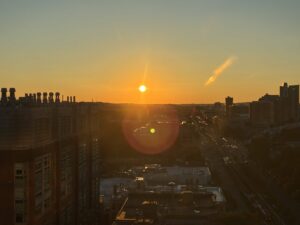
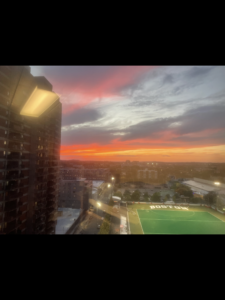
If you were curious, I took this photo from a close friend of mine whose room is in Warren C on the 18th floor (the highest floor). She has some amazing sunset views and I am always so jealous of her room!
–
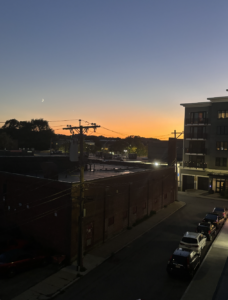
The official sunset time was 6:55 PM, so I started taking pictures around 6:40 PM from the same location. However, the sun itself was already mostly out of view by the time I started taking photos, so from my position it appeared to set before the official sunset time. I think this happened because the western horizon was blocked by buildings, trees, and hills, so the sun disappeared behind them before reaching the actual horizon. For the Autumnal Equinox observation next week, I would choose a location with a more open view toward the west, stay in exactly the same position, and take photos at regular time intervals so I can record the sunset more accurately.
–
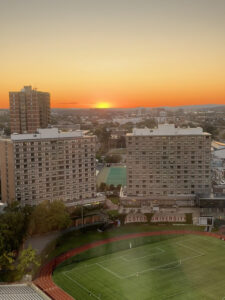
My best picture (image 2, taken at 6:55) shows the sun already faded to a glow at the horizon, suggesting it visually set a few minutes before the official time. This is likely because official sunset times are calculated for a flat, unobstructed horizon. However, my view from a high floor was partially blocked by distant buildings, causing the sun to disappear from sight earlier. For the Equinox, I’d improve data collection by shooting from the same fixed spot, taking photos every 1–2 minutes starting about 20 minutes before official sunset.
–
The sun fully went down after the 6:55 p.m. estimate on the weather app. I think this is because it differs depending on where you are. Also, it takes a while for it to set. To improve data collection, I’ll try and find a place where buildings aren’t blocking the sunset. It was kind of hard to see when it actually went below the horizon, but it was still pretty!
–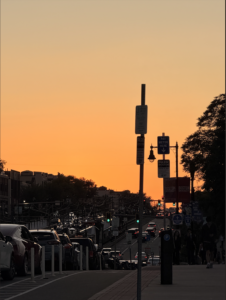
This photo was taken at 6:53PM from floor 12 of Stuvi II. According to the website Time and Date, the sun was predicted to have been completely “set” at 6:55PM. With that in mind, I would say from my perspective the sun was very aligned with the given time.
In the future I’ll stay until it’s completely set to assure I know just how accurate the prediction is and/or if what I’m seeing is the result of sun rays even though the sun has already set.
–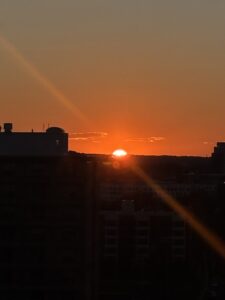
I did my test run in 820 Comm Ave because it has the best west facing windows I know of. The orb of the sun appeared to set right when predicted, but I don’t know when it dipped below the true horizon since there were so many buildings in the way. I noticed I was still able to see sunlight for twenty or thirty minutes after the official sunset time, which the Openstax readings attributed to atmospheric diffusion. I wonder what astronomers consider the end of a sunset – the sun crossing the horizon or the settling of darkness? Before next week I’m going to keep eyes out for vantage points where I can see the natural horizon without so much architecture. I’m unsure if I’ll be able to, but I think it would make it easier to tell when the sun has definitively set.
–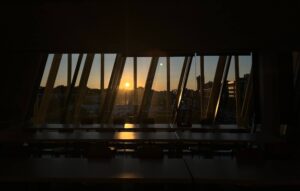
I took this image a little after 6:56, which was the time for today. The sun seems to have set later than the designated time. This could be because the calculated time doesn’t match the time it actually takes for the sun to set. My guess would be that since the Earth is on a tilt, the exact time the sun hits a point will vary slightly each day.
I know that the sun isn’t entirely noticeable here, I experimented with finding the best place to see most of the sun, the t tracks are a pretty good spot compared to Comm Ave or Newbury.
–
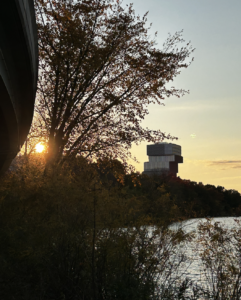
In the attempt to find a generally clear view of the sunset, I went to the Esplanade to see if that would be a good location to get pictures. However, I couldn’t really get a good view of the sunset but managed to capture a few pictures in the minutes leading up to the official time of the sunset (6:55pm). Despite the timing, I think there is still quite a bit of light out long after, and I believe this could be because we’re coming up on the equinox but I’m not sure. For the autumnal equinox, I will try to find a better spot, likely somewhere facing directly west so that I have a clear view, and can also understand the path of the sunset and the amount of time it takes for light to dissipate.
–
It set before the official time of sunset. I think my angle was really bad, and I missed a large part of the sun’s descent. There were some pretty tall buildings in the way as well.
Next time, I’m going to try to get a higher vantage point. Maybe the top of CDS will do. Since the sun isn’t directly west right now, I’ll need to find a place that isn’t just looking down comm ave…
– IMG_0818-1.pdf
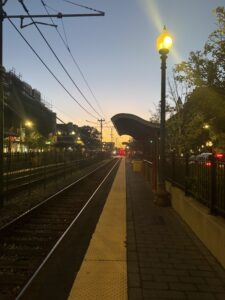
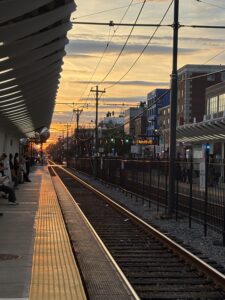
At around 7 p.m., I looked up from the T station toward the setting sun. I’m fascinated by the beauty of it, namely in how vibrantly it colors its surroundings and contrasts with the clouds. A sunset seems to emphasize the world around it, creating unique reflections in metal and plastic. However, it’s for that same reason, its vibrancy and complexity, that I do not think the station would be a good place to carry out the experiment. It seems like it would be easiest to define true west in a more isolated environment, where the Sun is more cleanly defined and its position is not obstructed by surrounding infrastructure.
–
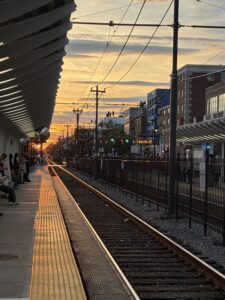
At around 7 p.m., I looked up from the T station toward the setting sun. I’m fascinated by the beauty of it, namely in how vibrantly it colors its surroundings and contrasts with the clouds. A sunset seems to emphasize the world around it, creating unique reflections in metal and plastic. However, it’s for that same reason, its vibrancy and complexity, that I do not think the station would be a good place to carry out the experiment. It seems like it would be easiest to define true west in a more isolated environment, where the Sun is more cleanly defined and its position is not obstructed by surrounding infrastructure.
–
I took my picture at 6:48pm and the sun was just barely peeking out from the horizon. The official sunset time was 6:55pm so I think having a higher vantage point would be more helpful in the future. It is difficult to get a really clear view of the sun setting because there are so many obstructions in the city. Ideally a high rise or some tall viewing point would be nice to watch the sunset from.
photo:
–
This photo Was taken around 6;30. Next time I will try earlier and later times, and also from a place of more visibility and outside.
–
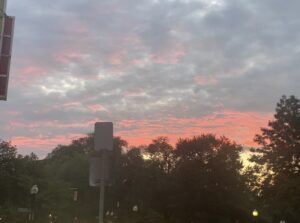
This photo was taken around 7 pm and the sun had already gone behind the trees so I was left with the afterglow. The sky had broken off into these small groups of rippled clouds and was covered in pink which allowed the sky to stay lit despite the Sun setting. Although it is a very nice picture, it is a bad measurement because the treeline and buildings along the Common cut off everything below maybe ten degrees, so I never saw the sun meet the horizon. The one thing working in my favor is the signpost, which gives me a fixed vertical I could shoot against every night. For next week, it would be smarter for me to get out there twenty minutes earlier and either find a gap in the trees or go somewhere with actual open sky to the west.
–
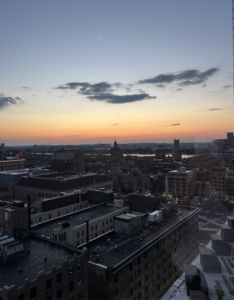
This photograph was taken at 7:12, 10 minutes after my weather app said the sun was going to set. I think it set later from my perspective because i took this at a restaurant where I was sat higher up, therefore it took longer for the sun to set fully behind the buildings. I think for next time I would try to be outside instead of inside to take the photo for more accurate results.
–
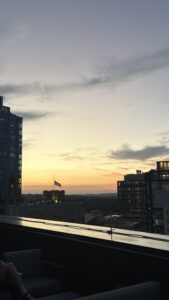
The sunset was 6:52PM EST, therefore I took the pictures during that time. However, by then, at least from my apartment view, the sun was setting very fast and it was hard to capture it from my angle. This happened I think mainly due to the buildings covering the areas where the sun would be visible (as it would moving diagonal from my view). For the Autumn Equinox, I will attempt to take the photo where the sun is more visible, in a more natural space, towards more to the west, and at a range earlier and later, with more photos tracking the progress.
–
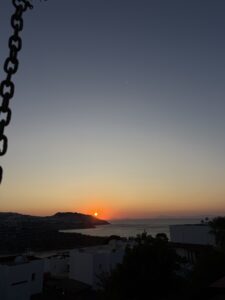
The sun appeared to set later than the official sunset time. I took this picture from my parents’ house in Bodrum, Türkiye, while tracking the sunset over a video call. One reason the sun seemed to set later may be atmospheric refraction, which bends light near the horizon and makes the sun appear slightly higher in the sky than it actually is. In addition, the official sunset time is usually defined as the moment the upper edge of the sun disappears below an ideal horizon, while local landscape features and viewing conditions can affect what an observer sees. To improve data collection for the Autumnal Equinox experiment, I would take photographs at regular intervals from the exact same position, record the precise times of each image, and choose a location with a clear, unobstructed view of the horizon.
–
This photo was taken on This photo was taken on September 16 at 7:01 PM while I was walking toward the dining hall. I noticed how beautiful the sky looked and thought it would be a perfect opportunity to photograph the sunset. Although the sun itself was already below the buildings and horizon from where I was standing, the bright orange and pink colors were still clearly visible in the sky. From my perspective, the sun seemed to set a little earlier than the official sunset time because buildings, trees, and other objects blocked my view of the actual horizon. This showed me that where I stand can affect when I observe the sun disappearing. For the Autumnal Equinox next week, I would choose a higher or more open location with a clear view of the horizon. I would also arrive earlier and take photos from the exact same position at regular intervals so that I can better document how the sun changes as it approaches the horizon.16th at 7:01 PM. I was walking towards the dining hall and decided that the view was gorgeous and would be perfect for a photo.
This photo was taken on September 16 at 7:01 PM while I was walking toward the dining hall. I noticed how beautiful the sky looked and thought it would be a perfect opportunity to photograph the sunset. Although the sun itself was already below the buildings and horizon from where I was standing, the bright orange and pink colors were still clearly visible in the sky. From my perspective, the sun seemed to set a little earlier than the official sunset time because buildings, trees, and other objects blocked my view of the actual horizon. This showed me that where I stand can affect when I observe the sun disappearing. For the Autumnal Equinox next week, I would choose a higher or more open location with a clear view of the western horizon. I would also arrive earlier and take photos from the exact same position at regular intervals so that I can better document how the sun changes as it approaches the horizon.
Not sure why my photo didn’t upload!
Trying the photo again, LOL!
Third time’s the charm!
–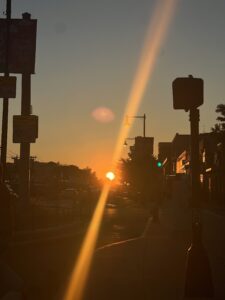
The Sun appeared to set after the official sunset time, likely because atmospheric refraction makes the Sun appear slightly higher than it actually is near the horizon. For the autumnal equinox, I would improve data collection by recording the exact time the Sun first touches and completely disappears below the horizon, while also noting the location, weather conditions, and taking photos to make the observations more accurate.
–
I took this picture at 6:30pm on September 16th from Larz Anderson Park in Brookline. The official time of sunset was 6:52pm that day, but the sun had completely set by 6:50pm, a little earlier than expected. I took photos at 5-minute intervals and had a clear view of the sun’s horizonal and downward movement. The park is on a hill, and the elevation provides a beautiful view of the sunset, so I’m planning to take pictures of the sunset on the Autumnal Equinox from this same vantage point.
– Sunset-Sept.-16.pdf
I already did what’s due week 2, but since I don’t see it in the chat, i will upload it again.
There was an indication that the sun had gone down even though officially it had not done so yet at the recorded sunset time. I suspect that this happened because I had been praying Mincha prior to the sunset, and therefore I had gone out of my house to take the photo much after I was done with the other activity. Hence, the difference in my observation time and the recorded one. In order to collect better data in anticipation of recording the Autumnal Equinox, I intend to take the picture nearer the recorded sunset time and take some photographs every minute before the estimated time of sunset.
– IMG_7242-3.pdf
Due Week 3
⤹Click the reply button just below.
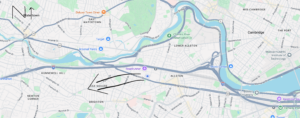
I am pretty confident about my location on the map because I know where I was standing when I took the pictures. But I am not very sure about the exact direction of the sun. There were buildings, trees, and some other things blocking the horizon, so it was hard to see the exact sunset point. I could still tell that the sun was setting toward the west. I think using landmarks like buildings, roads, and utility poles can help me compare the photo with the map and make the direction more accurate. Next time, I would also try to stand in the same place and record the direction more carefully.
–
I based this off of the photo I took for the week two homework because I’ve been having bad luck with clouds the past few days. I am fairly confident in these findings, the arrow is pointing mostly west and slightly south. This makes sense since the sun sets in the west and we are approaching the vernal equinox in the northern hemisphere, so the sun is in the southern part of the sky. I think my findings could be more accurate if I had a better reference building in the foreground. In my photo I can tell the sun is directly above a building, but it’s just far enough away that I can’t tell which building it is on the map.
–
I took my photo from the 18th floor of warren tower C. I did not have many major environment markers to follow the movement of the sun, but I have many buildings that I could choose to follow.
–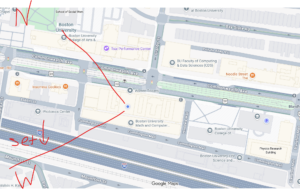
I am fairly confident in my findings because I used landmarks from my photograph to compare my view with the map. I took the photograph from Student Village II 17th floor, and landmarks like BU dorms, the soccer field, and the surrounding buildings helped me determine which direction I was facing. By matching the landmarks in my photograph to their locations on the map I was able to more accurately determine the direction of the setting sun.
–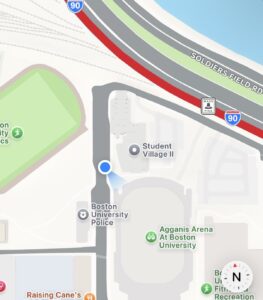
I am very confident in my location because I knew exactly where I was standing. I am also fairly confident in the angle of the photograph because I found several fixed landmarks that matched the previous picture I took, and I used the same zoom level so I can do a very clear comparision with my previous pictures. My main concern is the sunset’s exact position: it was cloudy this afternoon, so the sun was blocked before it fully set. Still, I could approximate its position because I knew it would be setting diagonally. Next time, I would try to take the photograph on a sunny day so that the sunset position will be observable
–
My week 3 photo was taken from my accommodation in Stuvi II. I am quite confident in using this position to track the suns course as it sets. This is due to Rich Hall acting as an excellent landmark/reference point when comparing two photos.
–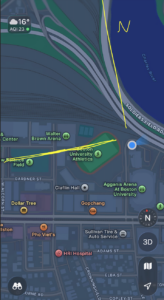
I’m confident in my location because I took these pictures from the same spot in Larz Anderson Park in Brookline. In the photo I took of the sunset on the 16th the sun was to the right of the two towers I was using for reference, but today at the same time it’s on the left of those towers. Hopefully Wednesday won’t be as cloudy and I’ll get clear pictures using the towers and trees as landmarks from this same location.
– Map.pdf
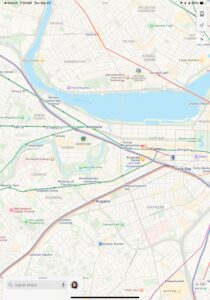
I am mostly confident in the direction I’ve picked as west. A key landmark in my photo is Copley so I used that as a benchmark of which direction it points. I think using key buildings as bechmarks can make it more accurate similar to the photos presented last time where we used the rock and the people around it as benchmarks to which direction the sun was setting.
–
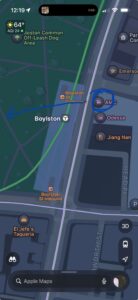
For this I was on the second floor of AMC. I thought this would give me a good view of the sun setting but it wasn’t like I thought it would be. For the equinox, l’ll probably go to Stuvi 1. I think there will be better markers for the sun set, as well as a better view.
–
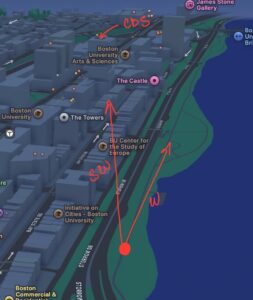
I’m fairly confident in my position along the bank of the Charles River as I was on the esplanade facing eastwards, towards CDS. I used CDS as my landmark both on the map and in the picture as I was trying to orient myself and compare the setting sun to a landmark. It looks like the sun is setting southwest and not true west.
–
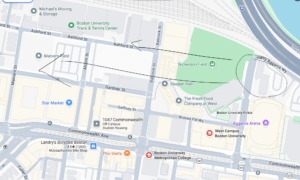
I chose to retake my photo at the Stuvi 2, on the 26th floor, where there are windows surrounding all four corners, north east south west, to make sure I can capture the sun setting at the tallest point of view (as it is the tallest building so no buildings are covering it)
–
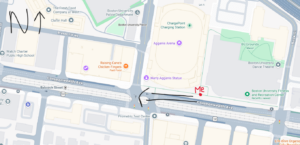
I am very confident about my location on the map. Since I took my photo on a part of campus that I am very familiar with, I was able to identify where I was standing when I took the picture. Obviously, it is difficult for my location and the direction of the sunset to be completely exact, but I am confident that my markings are fairly accurate. I could improve the accuracy of my findings by using landmarks visible in the photograph, such as buildings, sidewalks, or other recognizable features on campus. By comparing where these landmarks appear in the photo with their locations on the map, I could better determine both my exact position and the direction I was facing when the sun set.
–
I am fairly confident in my location and my findings because there are very distinct landmarks to identify the exact direction the sun is setting in. I would use the shape of my landmarks, all mostly rectangular, to determine the exact angle against which I’m viewing the sun. The uniform shapes in the skyline make it easy to decide where the sun sets
–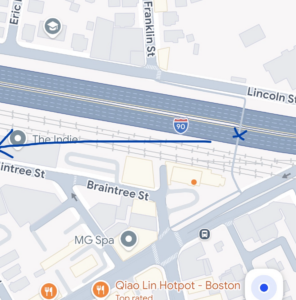
I am confident about the direction of the sun because the T station I was at created almost a tunnel pointing me in the correct direction. However, moving forward, I would want to take more photos earlier in the night so the sun could be more distinct, and higher up. Landmarks like the power lines and nearby buildings could help me truly pinpoint the direction the sun is setting in.
–
I took my photo from the roof of my apartment building. I am somewhat confident in these findings. The accuracy of my findings would be greatly improved with a slightly higher vantage point and a more distinct landmark. A lot of the surrounding building were all a similar height.
–
I’m confident about my position since I was on the roof and pulled the coordinates straight off the map. The sun drops behind the buildings around Kenmore Square before it reaches the true horizon. To improve this I’d use fixed landmarks that show up in both the photo and the map, like the Citgo sign, which is tall and close to due west of me. Lining the sun up against the edge of it would give me a real angle instead of a guess.
–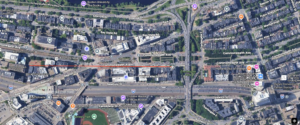
Not my original picture that I used for week 2 but I decided to take few more from the campus. The one I liked the most was the photo I took the photo in front of the George Sherman Union on Commonwealth Avenue. The sun appeared to set around the same time as the offical just a few minutes off, I think that might be because of where I was taking it from. I got a great shot right as the sun was setting the photo had buildings along the side of the street. But the Green Line tracks run right down the middle of Comm Ave, so I could use the tracks and the direction the train is heading to figure out exactly which way I’m facing.
–
I am sure about my results, since I was able to verify them through comparison with Google Maps and finding out that the calculated coordinates were close to the real ones. The verification of results with a trusted mapping tool allows me to have faith in the correctness of the method I used to obtain these coordinates. One of the ways to make my results more accurate is to find fixed landmarks on my pictures with known GPS coordinates and use them to triangulate myself. Landmarks of a known height can be used to get more precise angle of the sun elevation from the length of its shadow.
–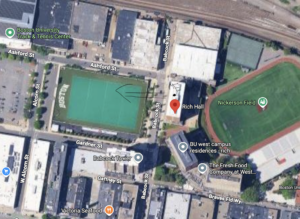
I am quite confident in my findings because I remember where I was standing, and also my phone provided a map with the photo, so I checked just in case and so the Sun was setting generally toward the west, even a little bit more south-west from my view and the photo. I also used the direction and where the charles river is to understand my direction and if it was correct, as I was looking front there was the charles river and its direction is towatds the north, and so to the left it was west. However, the direction might not be completely exact just from looking at the photograph. I could also improve the accuracy by actually using buildings, streets, or other landmarks visible in the photograph and finding the same landmarks on the map. This would therefore help me determine the exact direction I was facing when I took the photo.
–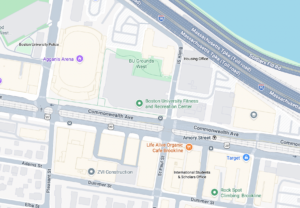
I submitted wrong map here is the correct one
–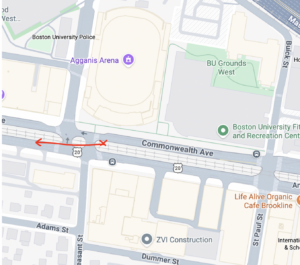
I am quite confident in my findings because I remember where I was standing, and also my phone provided a map with the photo, so I checked just in case and so the Sun was setting generally toward the west, even a little bit more south-west from my view and the photo. I also used the direction and where the charles river is to understand my direction and if it was correct, as I was looking front there was the charles river and its direction is towatds the north, and so to the left it was west. However, the direction might not be completely exact just from looking at the photograph. I could also improve the accuracy by actually using buildings, streets, or other landmarks visible in the photograph and finding the same landmarks on the map. This would therefore help me determine the exact direction I was facing when I took the photo.
–
I submitted wrong map here is the right one (also for the late response my comments do not work and then paste as duplicates and I do not know how to fix this)
–
I am fairly confident in these findings, I have a good view and a good landmark for recording the setting sun. The landmark I chose was 808 Comm Ave, and I took the photos from the 10th floor of CDS in the left most corner when you face the building as you enter. The sun set directly behind the Howard Thurman center and behind some unknown landscapes in the distance. Relative to Comm Ave, it seems to be setting due west.
The coordinates for the Howard Thurman Center are 42.350304498226805, -71.11165286523192, these coordinates show that the sun set at an azimuth of 271. The sun sets perfectly due west at 270 degrees during the equinox. Due to the latitude of the building, the angle is slightly off of 270 degrees a little more north of true west which is why it isn’t exactly at 270.
–
I am relatively confident in my findings of what direction the sun sets in. I’ve used the location of where the sun sets and marked the landmarks around it to help me specifically pinpoint it as well. The landmarks will help me get the most specific location of the sun and where it sets. On top of that, I also marked these locations on a map and that will help me specifically find what the exact direction is in which the sun sets. The sun looks like it sets slightly south of due west at this point in the year.
–
Due Week 4
⤹Click the reply button just below.
I took the photo on the bridge from Fenway to BU campus. I got lucky, and I got a great photo actually right as the sun was setting. The photo I used doesn’t actually have a ton of landmarks in it, just a few small buildings to the side. But I could maybe use the train tracks in it/train direction to figure out what direction I’m looking precisely.
– IMG_0849.pdf
I took the pictures on floor 26 at Stuvi 2. It does appear to be setting due West. In my picture it looks like it may be south in relation to commonwealth, but thats because I’m a bit north of it. To make sure I opened my maps app and position it as if I were in Stuvi 2 again. I angled it so it would be pointing due West and it was pointing towards where the sun appears in my picture.
–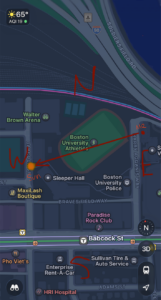
Under these two photos, which was taken on the 23rd of September, I am pretty confident that the direction of the sunset of true west. Although the sun wasn’t completely at the horizon line, I would estimate that this is close enough to consider the sun to be setting.
I took the photo from the 26th floor of stuvi 2, and using sleeper and rich hall as reference points I am able to pinpoint the direction in which I am looking. In the photo it may have not been perfectly westward facing, this is due to the fact that I took the picture earlier in the sunset rather than letting it descend more westward. I would consider this angle to be more Southwest.
– street-view.pdf
I can only add one picture at a time so here is my other picture of the sunset
– sunset.pdf
The sun appears to set due west because, using the Howard Thurman Center for reference, the angle the sun sets is at an azimuth of 271 degrees. True west for the sun to set on the equinox is at 270 degrees, which is very close to the recorded azimuth using the coordinates of the buildings on maps. I used the Howard Thurman center as my marker, even though the sun set further in the distance behind some hills. This was still a good marker because the coordinates of the building are close to true west. The coordinate is off by a degree because our area is slightly more north than true west. Relative to Comm Ave, the sun set on a slight angle to the left, but Comm Ave isn’t running directly true west so it makes sense there is a deviation. I took the photo from the 10th floor of CDS, which is slightly more north than the Howard Thurman Center due to it being on the right side of Comm Ave.
–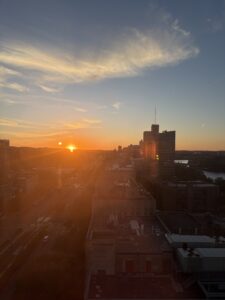
I took this photo on 9/23, on warren towers C 18th floor overlooking the rest of comm ave. Even though the photo is not very clear, I was able to see true west thanks to the building that perfectly met the location of when the sun went down (the edge of the photonics building). From now on, I will know that the edge of the photonics building is west, regardless of the day or time! That is pretty cool. The day was luckily very clear, as I was expecting the sky to be cloudy.
–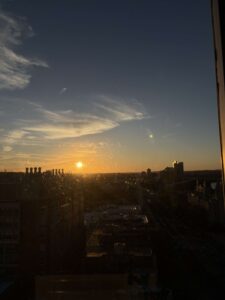
I took this photo on September 23 at around 6:50 p.m. near Boston Landing. From my position, the sun appeared to set very close to due west, but maybe a little south of west. I judged this by comparing my location and the direction of the sunset on the map. I also used nearby landmarks, especially the New Balance Center, to help me understand the direction I was facing. Since this photo was taken only one day after the Autumnal Equinox, I think the sunset position was very close to true west, although buildings and trees made it a little difficult to see the exact horizon.
–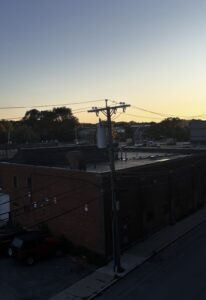
I took this photo of the sunset on Wednesday 9/23 by the BU Bridge facing towards Allston & Cambridgeport, and facing the western horizon. I used the Charles River as my landmark, and to map west as upriver would be W/SW. Because of this, I believe that the sun set in the direction of true West, which could also be seen when I used a mobile compass to estimate the cardinal directions.
–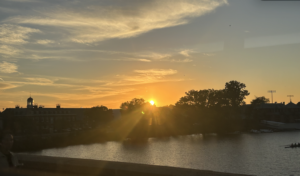
I took this photo of the sunset on Wednesday 9/23 by the BU Bridge facing towards Allston & Cambridgeport, and facing the western horizon. I used the Charles River as my landmark, and to map west as upriver would be W/SW. Because of this, I believe that the sun set in the direction of true West, which could also be seen when I used a mobile compass to estimate the cardinal directions.
–
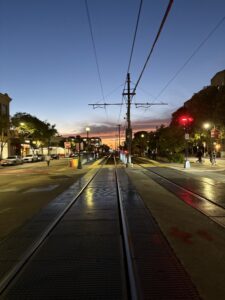
I took this photo on September 23, standing on the T tracks near BU Central. The sun does appear to set due West, which can be deducted from analysis of the nearby landmarks. It’s dipping into the horizon in the same direction as the far-off Howard Thurman Center and BU Central T Stop. I especially enjoy this photo because of how I can use the T tracks to create a tunnel/telescope of sorts, directly pointing me to the seeting sun in the West.
–
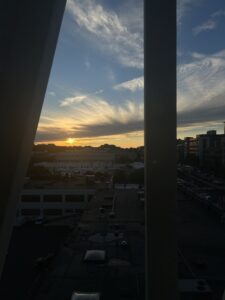
I took my picture on Thursday, September 24th because of clouds the day before. I photographed the sun from the fourth floor of 820 Comm Ave, the same location as my trial run. This time I made sure to know which buildings were in the foreground of my image, which allowed me to use the windows on one of them as a reference point on a map. I also used Google Earth instead of Google Maps to locate myself and the sun. Google Earth is much more detailed and it helped the mapping feel more accurate. The Sun did not appear to set perfectly due West. When I drew an arrow from my location to my reference window, the line sloped slightly south of west. I’m not entirely sure why, maybe due to the perspective at which I took my photo or being a few days away from the equinox? It’s not a tremendous slope, but it’s still noteworthy.
–
This photo was taken on 22nd of September at 6:40pm. The location was 9th floor of 512 Beacon street facing the NE of charles river. Sunset was set to be at 6:41pm. I was not facing West, therefore I was unable to locate the sun in the photo as I was limited to just one direction.
–
Photo taken using Rich hall once again as my landmark. Unfortunately it blocked the path of the sun this night and I was unable to see a clear horizon line. In the future I may look to change to a location in Stuvi that gives me a better angle.
–
I took this picture on September 23rd at 6:25pm, just as the sun was dipping below the horizon. I took it from the same place as the photos I took on September 16th, in Larz Anderson Park in Brookline. Based on my location and mapping, I would say the sun did appear to set due west, at 269 degrees.
– Sunset-Sept-23.pdf
I took this photo on September 21st, around the sunset time 6:30-6:45 range. At first, I went to my friends’ apartment at Stuvi, to see if I could catch the sunset, however, I then went to the top 26th floor, as that floor has windows facing North, East, South, and West of the city, at a high level as well, making it easier for me to catch right when the sunset dipped below the horizon. Based on the map from week 3, the sun was due west, as the sun in the photo set at the direction facing gardner street, which was further down Allston (West part).
–
I took my photo from the 4th floor of the GSU, at an angle where I could still see the sun. I think the sun set roughly west but it’s difficult for me to tell if it was precisely due west. It appears it set just a few degrees to the left of the face of the College of Fine Arts. The buildings side is around 5 degrees to the right of true North, and the sun in my photo seems to be somewhere between 5 to 10 degrees off the face of the building which would put it roughly due West with a margin of error of 5 degrees.
–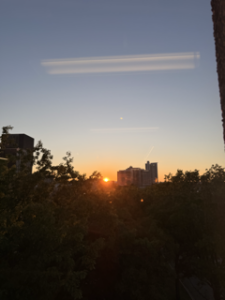
I took this photo on September 28, 2026, just after 6:30 pm, from the third-floor window of my apartment at 22 Bradbury St in Allston (approx. 42.358° N, 71.132° W), looking west over the neighboring triple-deckers.
A thick band of clouds sat low on the horizon, so the solar disk itself was hidden, but its position is clearly marked by the brightest, most saturated part of the glow just above the tree line.
The sun did not set exactly due West, though it came very close. Because I observed six days after the equinox, the sun’s declination had already shifted to about 2.4° south of the celestial equator (used AI to know this). At Boston’s latitude, that puts the sunset at an azimuth of roughly 267–268°, or about 2–3° south of due West. I could tell by locating my position on Google Maps, tracing my line of sight to the brightest point of the glow, and comparing that bearing to 270°.
A difference of only a few degrees is hard to detect by eye, especially with clouds and buildings blocking the true horizon, so a clear evening, a compass reading, and an unobstructed view would make the measurement much more precise.
– Screenshot-2026-10-05-at-1.23.53-PM.pdf
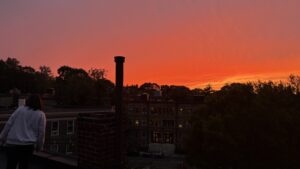
I once again took this photo on the roof of my apartment building. I know from week three’s project that the sun drops in the general direction of a nearby apartment building and the green line outbound to Boston College, though there are no major distinct landmarks. My phone has a compass app, so I was able to confirm the sun appeared due west (a marker of the equinox) that way. In addition, I used the direction my arrow was facing on the map app to determine where I was in relation to landmarks.
–
Due Week 5
⤹Click the reply button just below.
All of the info is in the PDF!
– Autumnal-Equinox-final-Fieldwork.pdf
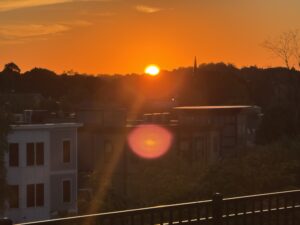
The sun did not appear to set exactly due West. After it disappeared below the horizon, I used the Compass app on my phone and pointed the phone in the same direction as the sunset. The compass showed approximately 281°, which is about 11° north of due West (270°). Therefore, the sun set slightly west-northwest rather than directly west. I am fairly confident in this observation because I stood in the same location as before and kept my camera angle and zoom level consistent. I also used several nearby landmarks to confirm both the direction of the sunset and the angle from which I took the photograph. These fixed objects made it easier to compare the sun’s position and check that my camera was pointed in the intended direction.
–
This photo was taken on 22nd of September at 6:40pm. The location was 9th floor of 512 Beacon street facing the NE of charles river. Sunset was set to be at 6:41pm. I was not facing West, therefore I was unable to locate the sun in the photo as I was limited to just one direction.
–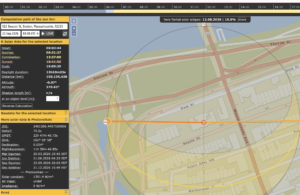
image of the sunset
–
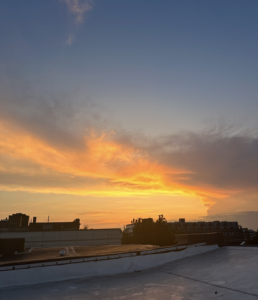
I took this photo from my neighbors rooftop at about 6:20 pm last Wednesday. It was just starting to get cloudy before the Nor’easter so it was a little tricky to figure out the exact angling of the sun and my neighbor could only give me roof access for a brief window. I was angled to the sun on the west side, so I feel like I was looking at the sun directly face on. Here is the photo that I took and I think I will continue with this angle next week to see if I can get a clearer view.
–
I forgot to mention this in my comment above, but it seemed as though the sun was reflecting into the clouds and that is why the lighting seems so vibrant from an under angle.
I took the photograph from the 17th floor of Student Village II and used Sleeper and Rich Halls as reference points to determine my viewing direction on the map. Because I took the photo a few minutes before the sun fully set, it was slightly south of its final position, though only by a degree or two, since the sun’s direction changes slowly near the horizon.
–
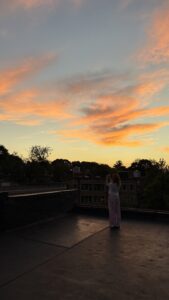
I took this photo on the roof of my apartment building. A convenient location for this project. The official time of sunset in the Boston and Brookline area when I took this photo was at 6:40 PM. The sun set a little after the official time. This photo was taken at 7:01pm, and the sun still appears to be setting. I suppose this could be due to atmospheric refraction or horizon obstructions. I might improve data collection in preparation for documenting the Autumnal Equinox by being consistent (taking multiple photos at the same location) and recording the exact time the sun first reaches the horizon and when it disappears.
–
The sun appeared to set slightly before 6:55pm. I took this photo from a dorm in Rich hall. In this photo the sun came out of my view and it was right after the sun had set, at the specific time it was predicted to set on my weather app. I think the sun could set early because of the way the Earth is tilted and where we are located. I think it could also set early because maybe there is a chance the human clock time is slightly off than the solar time. I think there is also a chance where I was located cut off my view of the horizon. So while it looked like the sun set from where I was, maybe if I had been higher up the sun would still be visible. For the following week, I think I need to be in a higher position to see the sun actually set on the horizon and not have my view obstructed by buildings.
–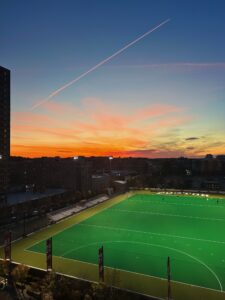
Unfortunately, as the sun set, the clouds moved in and covered the sun, but right before they did, I could see where the sun was in relation to the western horizon. From what I could see, the sun appeared to be exactly due west or as close to due west as I’ve observed. I used the surrounding landmarks – Star Market, Rich and Sleeper Hall, and the residential building across from Sleeper – to help me get the most accurate idea of where the sun is setting on the western horizon. I also took into consideration from last time to go to a higher location than Rich Hall. This final observation of where the sun is setting on the horizon is generally consistent with my previous observations. Unfortunately the clouds did make it slightly more difficult to pinpoint the exact location, I do believe my findings are quite accurate.
–
During the first week of this multi-week project, I took my initial sunset photo in West Campus, right in front of Boston University’s Agganis Arena. However, as the project progressed, I decided to change my observation location to the 13th floor of BU’s School of Law. I figured that being on higher ground would give me a clearer view of the western horizon and allow me to capture more recognizable landmarks in my photos. The two photos I am submitting were taken from this new location, with the first taken on September 21st at 6:40 PM, just before the Autumnal Equinox, and the second taken on October 7th at 6:10 PM. Unfortunately, the skies were fairly cloudy during my September 21st observation, which made it difficult to clearly see the sun as it approached the horizon. Because of this, I decided to take another photo on October 7th to get a better view. Since the sun is expected to set approximately due west around the Autumnal Equinox, I would expect my September 21st observation to be relatively close to that direction. However, by October 7th, the sun should have shifted slightly south of due west as we moved further into autumn. Overall, this project has helped me better understand how the sun’s position changes over time and how factors like weather, elevation, and observation location can affect our ability to track those changes.
–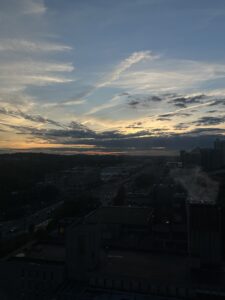
Here is the photo I took on October 7th!
–