The Harvard-Smithsonian Center for Astrophysics offers the public access to a network of small robotically-controlled telescopes. The following fieldwork assignment invites you to work with images collected from that telescope to replicate Galileo’s discovery that the planet Jupiter has a number of moons orbiting it.
Here’s what Jupiter looks like through one of the Harvard-Smithsonian telescopes, with a setting that shows the planet against a field of stars. Some of those stars are actually moons—but which ones?

Jupiter and its moons, 7:30am on 9/25/22
Jupiter’s moons differ from stars in two respects. First, they aren’t bright pointlike sources of light. When the telescope is adjusted to exclude pointlike sources of light, this is the result:
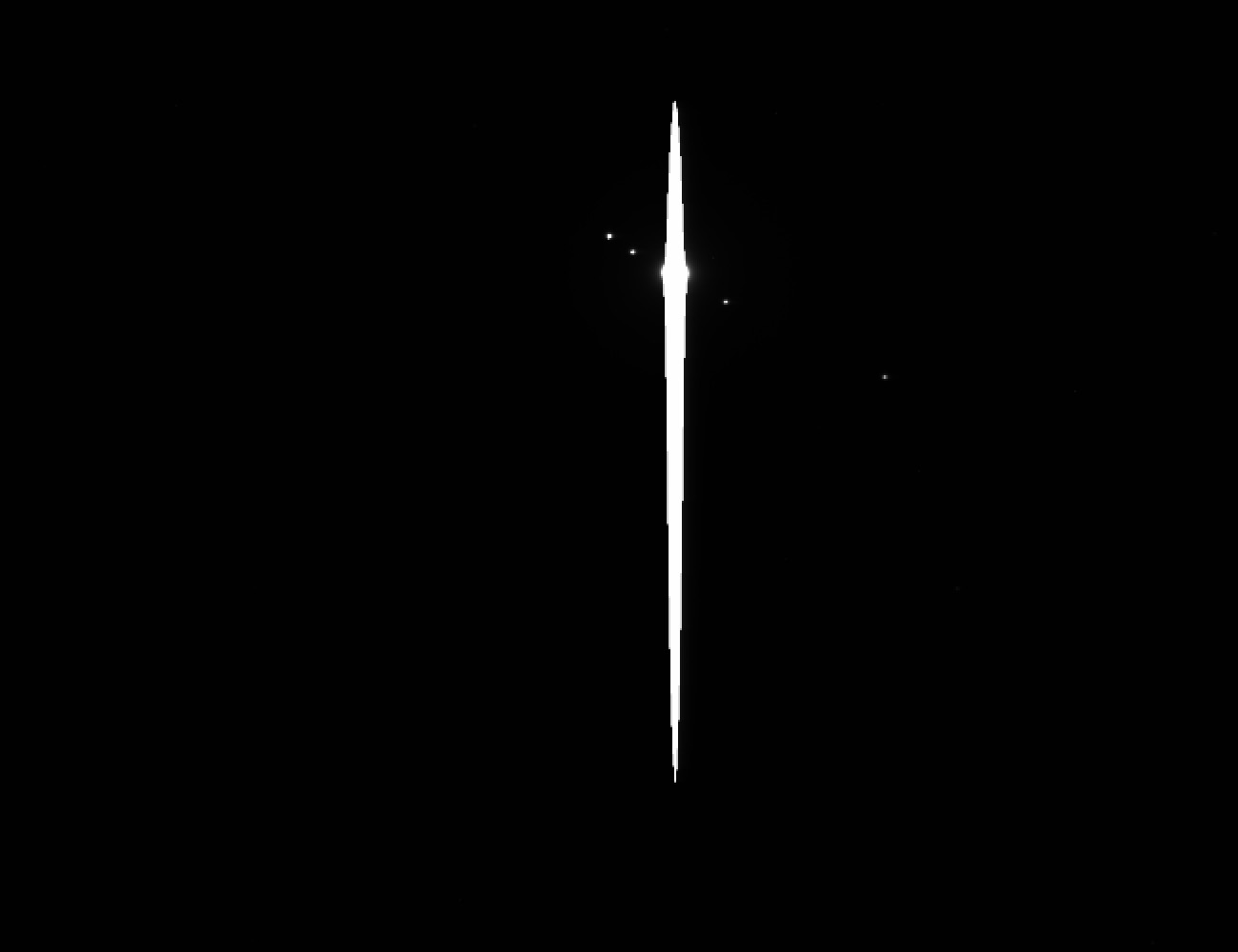
Jupiter and its moons, 7:34am on 9/25/22, filter set to highlight the moons
This telescope adjustment will help us a lot in our study, but what really sets Jupiter’s moons apart from background stars is that they MOVE. That’s the property that got Galileo excited, and it’s the one which we will focus on in this fieldwork. To detect the moons’ movement, we need to compare images taken over a sequence of hours or days. I’ve assembled a bunch of images for you (download here), but I’m leaving it up to you to decide which subset of these images to focus on.
Due week 7: preliminary
From the collection of 15 images linked above, select 3-4 that tell a story of the moons’ motion relative to Jupiter. Consider whether you get better results comparing hour-by-hour or day-by-day photos. Consider also how you might present this data, visually, to maximum effect? Post your reflection in the comments below.
Due week 9: final version
Report: drawing exclusively on the image set linked above, what can you conclude about the moons revolving around Jupiter? How many distinct moons do you see? Taking into account the timestamp of each image, are some of the moons orbiting faster than others? To be clear, your goal is NOT to get the “right” answer to any of these questions, but rather to get the best answer(s) you can based on the evidence available to you.
Your report should draw from at least three of the images, and should present them visually so as to highlight the moons’ motion. Image processing: to better isolate this motion, you will likely need to manipulate the images so that Jupiter is stationary. Note that all these images all have the same magnification and angle, so all you need to do here is shift the images up, down, right or left to bring Jupiter into the same position from one image to the next. Clear visual presentation of this data will be one factor considered in the grade for this assignment.
Options for your write-up:
- You can assume the persona of Galileo, one of his assistants, or a contemporary rival, writing in the early 1600s as one of the first people to see Jupiter’s moons.
- Alternatively, you can write from a modern perspective, evaluating your results by comparison to modern data (Wikipedia).
Either way, match your language to the occasion. Your writeup should detail the procedure you followed in processing the data, and should conclude by meditating on how your results might be improved upon.
Turn your report in by emailing it as a .pdf to Prof Henebry.
Show/Hide due Week 7
Show/Hide due Week 9
