Due Oct 7
Newton’s Laws; Halley’s Comet
How Newton’s theory offered mathematical rigor to Kepler’s Laws and thus cemented the Sun-Centered episteme.
Grant Proposal draft due
The draft for your Grant Proposal is due the Saturday after class. Email Dr. Henebry if you need a 24-hour extension.
Astronomy Reading
- Impey, Ch. 3.10-11, 3.13 (“Isaac Newton”, “Newton’s Law of Gravity”, and “The Birth of Modern Science”).
- Openstax Astronomy (pdf | online), Chapter 3.2-3.5.
Arts Assignment
Watch the 8-minute introductory video, then read Book 3 of Milton’s Paradise Lost. This is a challenging reading, so I encourage you to focus on a particular section from the list below. In 1-2 ¶s, comment on Milton’s cosmology as reflected in your chosen passage:
- Invocation, lines 1-55
- Description of Heaven, lines 56-76
- God’s pre-knowledge of the fate of Humankind and the Son’s willing self-sacrifice, lines 77-134
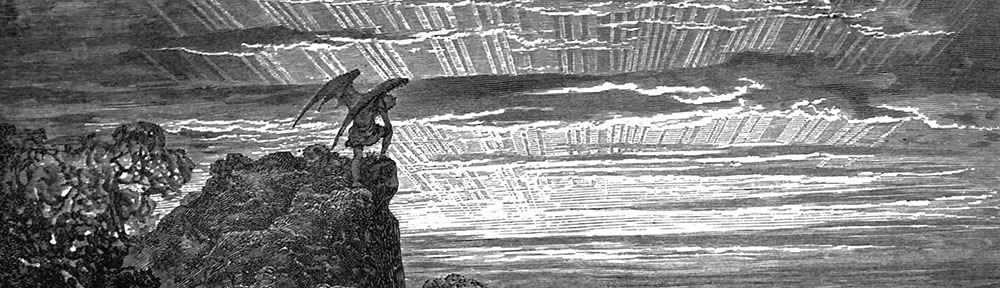
- Satan walks upon the stony exterior of the created world (i.e. the outside surface of the cosmos as we know it) which in times to come will be the “Paradise of Fools,” lines 416-500
- Satan sees the Gates of Heaven and the stairs by which angels travel down from Heaven to visit Earth, lines 498-554
- Satan plunges down past the multitude of stars to land on the Sun, lines 540-590
- Satan encounters the incredibly bright and alchemically potent substance that makes up the sun, then sees the angel Uriel, who stands sentry there, lines 588-629
- Satan disguises himself before speaking to the sun-angel and getting directions to Eden, lines 630-735
I chose to focus on Lines 1-55 about the Invocation for Milton’s Book 3. I chose the beginning because I believe he reveals the most pertinent information surrounding his understanding of astrology during this expository paragraph. In this introduction to his work, Milton reveals that his cosmology is neither solely geocentric or heliocentric as we have discussed in weeks past, but possibly adopts his own method of theocentric. He clearly indicates to both geocentric and heliocentric ideas existing in his work, yet seems to commit to neither and instead leans on God’s determinism to predict and structure the universe. We’ve read countless texts of civilizations revering the sun as a deity, but Milton very clearly begins this book by saying, “Hail holy Light, ofspring of Heav’n first-born”, which to me indicates his priorities astrologically. Before the sun, before the universe, before anything else: He sees God as the predecessor and creator of all the celestial objects and therefore removes the past patterns of idolizing the sun or moon. Instead, he places all of the reverence on God as the “holy light”, which reflects a universe beyond logical, physical structuring and resembles more of a universe that is symbolic and designed. In his understanding he sees light as a presence and extension of God instead of the literal universal source that would be the Sun. So in Milton’s cosmology, the geocentric and heliocentric debate is almost secondary and backseat to his personal truth: a Godcentric universe, where the mapping of the planets, the sun and the outer words of Hell are structured and orbiting by God’s will.
This ultimate perspective on the universe places Milton in a unique position of cosmology when compared to Copernicus and Galileo, as the science of the debate is no longer the totality of the argument and religion becomes a relevant factor. Milton’s view of light also positions him between science and faith. In short, he rejects total assimilation with either idea of geo or heliocentric and instead opts for a “Ethereal stream” of light and power that is the dominant universal model for him. The dominating factors of science and the intricate debates of epicyles, adjusting stars and other factors are thrown out in the margins and replaced with Milton’s blanket answer: faith in God to account for the complex and debated sciences. In this way, by rejecting both dominant ideas he builds his own cosmology that is unique by fusing belief and reason into a synthesis that creates its own unique thought process that guides the rest of his works.
In Milton’s Book 3 of “Paradise Lost,” lines 56 to 76 discuss the heavens and allude to where God and Satan are. As the video mentions that Milton was free-thinking and thought the universe more as a bubble, he offers a perspective that hell is not “below the ground,” and both heaven and hell are beyond the earth. Regarding God, the writer mentions “the Almighty Father from above” (line 56), referring to him being above earth. Additionally, his “High Thron’d [being] above all highth” (line 58) implies that God is sitting in heaven high above earth’s sphere.
More interestingly, Milton notes that Satan is “coasting the wall of Heav’n on this side Night.” Based on the website’s caption on this quote, this means that Hell is Chaos, which is beyond earth and even Heaven, at the edge of the universe’s bubble. This is an interesting statement because of the popularized saying that Hell is below humans. Therefore, to summarize, Milton suggests that Satan is not beneath the earth but rather in Chaos outside of the entire universe, including Heaven, which is also beyond earth’s atmosphere.
I chose to focus on lines 77-134, which discusses Satan approaching humanity and God’s reaction to it. In this excerpt, God comes to realize that Satan will try to corrupt humanity and He is unsure how to stop it. At first he would hope to shield humanity from Satan, but in doing so would not allow humanity to grow into the free-thinking children he wants. I think this provides an interesting examination into predestination and morality. Similar to the trolley problem, God has a choice to intervene at the cost of limiting the free will of humanity or let them be corrupted.
I chose to focus on God’s pre-knowledge of the fate of Humankind and the Son’s willing self-sacrifice, lines 77-134
This passage shows how Milton’s view of the universe centers on the balance between God’s power and human free will. When God says, “Sufficient to have stood, though free to fall” (99), it reflects a universe built on moral choice rather than strict control. God creates beings capable of doing good but also gives them the freedom to choose evil, because real obedience and love only have meaning when they come from free will. Milton’s world isn’t one of blind submission; it’s a place where moral decisions matter, and where freedom is part of the natural and divine order.
Later, when God says, “They themselves decreed their own revolt, not I” (115–118), Milton shows that even though God knows everything that will happen, He doesn’t force it to happen. People and angels are responsible for their own actions, which fits with Milton’s idea of a rational and just universe. At the same time, God’s statement that “Man therefore shall find grace” (130) foreshadows the Son’s willing self-sacrifice that comes soon after this passage. God’s pre-knowledge of humankind’s fall already includes the plan for redemption, showing that His justice and mercy are both part of the same cosmic design. In this way, the passage reflects Milton’s cosmology as one where free will, divine foreknowledge, and mercy all coexist in perfect balance.
Milton’s cosmology in Paradise Lost isn’t just about the physical structure of the universe (stars, planets, Heaven, Hell). In the part where Milton described God’s pre-knowledge of the fate of Humankind and the Son’s willing self-sacrifice (lines 77-134), Milton shows a universe guided by God’s knowledge but also freedom. Even though God already knows humans will fall, he does not force it as God has given Adam and Eve the freedom to obey or disobey, “… they themselves decreed / Thir own revolt, not I: if I foreknew, / Foreknowledge had no influence on their fault” (lines 116–117). This illustrates Milton’s philosophy that free will and predestination coexist or the fact that Milton did not fully believe in the Calvinistic idea of “predestination” (that God has already decided who is going to Hell and to Heaven). Milton also emphasizes that humans’ choices are meaningful because they are freely made, unlike the angels’ self-tempted rebellion. And because of this, human “shall find grace” (lines 131–132), meaning that God’s mercy through the Son will eventually allow them a way to redeem themselves.
The Son’s future sacrifice ensures humans can be redeemed, restoring the possibility of freely choosing obedience and accepting God’s mercy. In this way, Milton’s cosmology balances human free will and divine mercy: everyone has to be responsible for the outcome of their decisions, but God always provides a path back, making redemption more meaningful. The universe is ordered around justice and mercy, and God’s foreknowledge ensures it goes according to his plan (him allowing the Fall of Man leads to “fortunate fall,” bringing more good out of the situation and making human beings greater). Milton’s ideas may also reflect deeper historical context. Living in a complicated society where people fight between the new and the old forces, or reformation and revolution, his poem reveals “his grief and anger of the failure of England revolution, and his wish for the coming revolutions for free will and rights in England.”
LitCharts. “Free Will and Predestination.” LitCharts, http://www.litcharts.com/lit/p.....estination.
Zhu, Feng-Mei. “An Analysis of Milton’s Free Will Defense from the Two Falls in Paradise Lost.” Journal of Literature and Art Studies, vol. 4, no. 12, Dec. 2014, pp. 1037–43, http://www.davidpublisher.com/.....96ad51.pdf.
I chose to go with the Invocation, lines 1-55.
In the opening of book 3, Milton addresses “holy light, offspring of Heaven first-born”, and describes it as a divine force that existed “before the Sun, before the Heavens”. Milton calls it the “bright effluence of bright essence increate,” showing it not only as physical light but as something that is forever lasting and sacred. Since Milton was blind, this section feels very personal and emotional. He describes how his eyes roll in vain to find light’s piercing ray(“Revisit’st not these eyes, that rowle in vain, To find thy piercing ray, and find no dawn”), and he still asks this “celestial light” to sort of illuminate his mind. Here when Milton says “light,” he isn’t referring to his eyesight, but rather gaining spiritual and intellectual light. He believes this is an inner light sight that will allow him to understand the deeper truth without his physical eyesight. Milton is a firm believer that even in the darkness, through imagination and faith, the mind can see anything and access divine understanding. His blindness doesn’t limit him, it provides him a deeper level of awareness of a light that comes from within.
What really stood out to me about Milton’s view of these heavens is how he blends in faith with science. He lived during a time of several scientific discoveries, but nothing that was concretely confirmed, but he doesn’t separate knowledge from religion. His cosmology doesn’t fit directly into being either geocentric or heliocentric, it’s something larger, a divine system where both the physical and spiritual worlds coexist under God’s will. He understands that the universe is vast and has a lot of activity going on, but is governed by a higher power. Even though we cannot see everything or fully understand the universe, Milton believes that through faith and intellect combined, we can still observe the divine truth. To Milton, seeing isn’t about eyes at all, but about understanding creation and humanity through the light of God from within ourselves.
I chose the lines 416-500. Milton’s description of Satan walking on the “stony exterior” of the created world in this section demonstrates just how bizarre and intricate his conception of the universe is. The world we live in seems to be a physical bubble suspended in chaos, with an exterior surface that you can actually walk on, rather than merely floating in space. It’s a crazy picture. The universe appears more tangible and smaller as a result, resembling a massive work of architecture that God created. It feels like a real, organized location with boundaries and passageways connecting Heaven, Hell, and Earth; it’s not merely spiritual or metaphorical.
What I admire about this is that it also depicts Satan’s predicament. Like someone who has been shut out and is looking for a way back in, he is investigating the boundaries of creation. He’s physically blocked off from the world and everything wonderful, which demonstrates how far he’s fallen, but he’s still interested enough to keep going. In this scene, Milton’s cosmos seems both wonderful and isolated. For Satan, this vast, well-organized structure serves as yet another reminder that he is still on the wrong side of creation, regardless of how far he goes.
In these lines (56–76), Milton shows God looking down from His throne in Heaven to take in all of creation—Heaven, Earth, and Hell—in one sweeping view. God sits in the highest realm, the pure Empyrean, surrounded by angels “thick as stars” who are filled with joy just by being near Him. At His right hand sits His Son, the perfect image of His glory. Milton’s vision of Heaven is expansive and luminous, brimming with harmony and order. The universe is organized according to proximity to divine goodness and clarity, as evidenced by the way that everything in this area reflects light and life emanating from God.
When God looks farther down, He sees Adam and Eve in the Garden—still innocent, happy, and alone together—and then looks beyond them toward Hell, where Satan hovers at the edge of creation, ready to enter the world. The contrast between Heaven’s brightness and the dark “dun Air” outside it highlights the moral structure of Milton’s universe. Darkness symbolizes confusion and separation from God, whereas light stands for understanding, love, and order. There is more to Milton’s cosmology than just distance; it is about meaning: the further one travels from the light of Heaven, the more they stray from harmony and truth.
I chose to focus on lines 540-590 as Satan travels towards the sun. In this excerpt, Milton focuses on both the vastness of space and calling into question the geocentric model. In line 566, Milton describes the stars as distant. From what we discussed in class, it seems that this may be an understanding he took away from his time with Galileo. Stars were not always believed to be far away. In the geocentric model, the stars were simply the viewable constellations found around the earth. Milton questions this idea, and helps readers develop a deeper imagination of stars. Further, he writes that these far away stars, up close, appear to all be “other worlds.” He expands our idea of what the universe can hold, further questioning geocentrism. The Sun is also described by Milton as far away. It takes Satan years to reach it. I think the understandings of distance open readers’ minds to the true vastness of space. The mere distance represented forces readers to look beyond geocentrism. In line 575, Milton writes, “by center, or eccentric, hard to tell” in reference to the sun’s location. This is again an interesting nod to the geocentric versus heliocentric model of the time. I think the tone of this passage is interesting because of the way scientific discoveries are intertwined into its text—even Galileo’s telescope makes an appearance. In this section, Milton shows us how scientific understandings can create a dynamic view of religion. Do deeper understandings of the unknowable bring people closer to a sense of religion or farther from it?
I chose to focus on the section where God speaks about the fate of humankind and the Son offers to sacrifice himself (lines 77–134). In this section, Milton discusses the aspect of free will in human kind alongside the “perfect” world God has created. He mentions Adam and Eve ultimately using their free will to eat the forbidden fruit, choosing evil over good. God knew that they would make this choice, but allowed them to anyway because he wanted people to have free will. God’s son Jesus ultimately sacrifices himself for humanity, an act of God’s love for his people. This acts as a link between heaven and earth, God’s all knowing power and human choice.
I chose to write about lines 56-76, where Milton presents us with an image of the divine cosmology that brings together the Christian theology with Renaissance science and imagination. God the Father is described as reigning from the “pure Empyrean,” which comes from ancient and medieval cosmology that just means to the highest heaven; a place of pure light beyond the physical universe. God surveys all of creation at once: Heaven, Earth, and Hell. This very specific vision places Milton’s belief in an ordered, hierarchical universe structured around divine reason and moral order. There is a sort of spatial layering that puts Heaven above, Hell below, and the newly formed world suspended in between symbolizes both the physical and moral structure. It’s saying that we are in between, and depending on our faith and different things we can rise or fall to either side. Everything is sustained by God’s gaze and foreknowledge, emphasizing His omnipresence and omniscience.
Milton’s cosmology is not just a static description of heaven. The scene created by the poem shows the universe as a vast, living system filled with movement: Satan “coasting the wall of Heav’n,” Earth “imbosom’d without Firmament,” and God’s “bent down eye” linking all realms. This motion describes the tension between divine order and rebellious free will in the same cosmic drama that drives the poem. The description also tells us how Milton uses cosmology as a stage for moral vision: the “Empyrean” represents eternal harmony, while the “dun Air sublime” where Satan travels marks the chaos that comes from pride and disobedience. Milton’s universe is not just a map of physical space, but a moral and spiritual cosmos where every level reflects humanity’s relationship to divine authority.
I select lines 588-629 of Book 3 of Paradise Lost to focus. In this part, Milton’s description of the Sun where Satan lands does not look like the Sun as we know it. Instead of being extremely hot, dangerous, and uninhabitable, Milton imagines it as a place overflowing with glowing metals, jewels, and rivers of “elixir” and “potable gold.” Milton presents light as more than a physical phenomenon — it becomes a symbol of divine presence, closely connected to God and Heaven. Milton also seems to think of the Sun as holy and mild because, from its outward appearance, it nourishes and sustains life on Earth. The same Sun that feeds creatures and makes growth possible becomes, in his poem, a spiritual emblem of creation itself.
From a symbolic viewpoint, the Sun is probably a visible reflection of God’s creative energy in the universe. And when Satan arrives there, he meets Uriel, the angel of the Sun, whom the poet identifies as “the same whom John saw also in the Sun.” Therefore, Milton’s entire universe is not shaped by science, but by meaning. As the video said, he thinks the entire cosmos, including Earth, Moon, Sun, other planets, and the stars are like a bubble, carved out of infinite Chaos by God, so that all of them are part of God’s will.
In lines 1-55 of Book 3 of Paradise Lost, Milton presents a vision of cosmology that blends classical and Christian imagery. He situates himself in a vast and luminous universe structured by divine light. After describing his own blindness, Milton turns to invoke “holy light, ofspring of Heav’n first-born,” calling the Light both as a creative force that shaped the cosmos and as a symbol of divine truth and grace. In Milton’s cosmology, light isn’t just physical but spiritual, radiating from God and illuminating all creation and enabling understanding. Towards the end of the passage, “Shine inward, and the mind through all her powers /Irradiate” reveals Milton’s belief that true vision is intellectual and divine, transcending the limits of human sight.
Milton’s cosmic vision situates humanity within a hierarchical, God-centered universe, where knowledge and creation flow from the divine source of light. The invocation becomes both cosmological and autobiographical, placing the poet’s personal struggle within the grand architecture of creation. For Milton, light is the medium of divine order in the universe, and through the poet’s inspired imagination, that order becomes perceptible even to the blind.
I choose to focus on lines 416–500 of Paradise Lost Book 3. Here Milton’s cosmology becomes architectural as Satan walks across the “stony exterior” of the created universe. I believe that Milton pictures the cosmos as a bounded, physical structure suspended within Chaos instead of being seen as infinite and formless. Like a massive sphere with an outer wall. This shows that creation is not random but carefully made and shaped by God, bringing order to the emptiness around it. The scene is also showing Satan’s place in the universe as being cut off from light and life. Satan is also shown wandering the edges of this universe, almost as if he is an exile trying to return. Milton connects the shape of the universe with moral ideas, and the clear borders of creation reflect the gap between rebellion and God’s order.
Using lines 540-590, In this passage, Milton imagines a vast and ordered cosmos where Satan plunges from Heaven’s edge through the stars to the Sun. The universe follows the old Ptolemaic model, with its concentric spheres and radiant harmony, but Milton fills it with spiritual meaning. As Satan moves through this bright, divine order, he feels both awe and envy—he can see the beauty of creation but remains cut off from its light. The Sun, “likest Heaven,” symbolizes divine presence and creative power, reminding us that Milton’s cosmos reflects God’s moral structure as much as His physical design. Satan’s flight through it becomes not just a journey through space, but a sign of his deeper fall from grace.
I chose lines 588–629. Milton describes the Sun as a place filled with rare materials and perfect light, comparing it to metals like gold and silver and to precious stones such as rubies and topaz (lines 595–599). He connects this brightness to the language of alchemy, saying the “Arch-chimic Sun” makes “Elixir” and “Rivers run / Potable Gold” (lines 606–612). This shows how Milton blends science, religion, and human imagination: the Sun is not only a star in space but also a symbol of divine creativity, where natural forces perform what human art can only attempt. His cosmology suggests that even as the universe becomes vast and mechanical after Copernicus, it still carries spiritual meaning.
Milton also focuses on how vision works in this radiant world. There are no shadows, and the clear air sharpens sight so Satan can see across great distances (lines 615–621). The scene combines physical optics with spiritual insight—light allows both understanding and revelation. When Satan finally sees the angel Uriel “whom John saw also in the Sun” (lines 622–629), Milton links observation with prophecy. The Sun becomes both laboratory and altar, showing that knowledge in his universe depends on illumination: seeing clearly in the outer world and within the mind.
In lines 498–554, Milton presents a cosmos where Heaven and Earth are connected by shining stairs that angels use to descend and ascend—a visible link between the divine and the mortal. This image shows a universe both orderly and permeable, with Heaven close yet morally guarded. When Satan gazes upon these stairs, he sees not only a physical path but a symbol of divine access denied to him. His exclusion highlights Milton’s moral cosmology: the universe’s structure mirrors its ethics, where movement between realms depends on obedience, not ambition.
In Milton’s Paradise Lost, Book 3, Lines 498-554, we see the path to Heaven from Satan’s point of view. One structural element that stands out is Milton’s insistence on the idea of stairs, ladders, and the difference between up and down. Satan “scal’d” and has to “ascend”, while Heaven is “high”’ and at the “top”, backed by the “Rising Sun”. In contrast, there is an “underneath” where angels “descend” and go “down” to. The stair between Heaven and Earth is a clear metaphor for the relative position of various elements in Milton’s cosmology: Heaven and angels on top, with the Oceans and Earth below, pointing to a strongly-held belief in proper order and hierarchy. Although Milton was strongly influenced by Galileo’s new heliocentric ideas, he cannot escape the older way of thinking- while the Earth is no longer the center of the Universe, there is still an order and hierarchy to Milton’s cosmos. In this cosmology, transition through space occurs by moving up or moving down, a way of thinking that roots this piece in a pre-quantum understanding of physics (where objects do not necessarily change position by moving up or moving down, but instead ‘jump’ between states). Satan, who symbolizes chaos, is locked out of this orderly, “beautiful” Miltonic world. By denying Satan, Milton denies chaos, non-order, and the eventual newer way of viewing the cosmos that will be available after the discovery of quantum physics in the 20th century.
Besides the contrast between up and down, high and low, there is also a clear distinction between light and dark, a contrast that the blind Milton would have greatly appreciated. As Satan wanders in the vast darkness, there is only one spot with brightness and light: the Earth and the Stairs to Heaven. The chaos and vast emptiness of non-life is only brightened by the one place graced by the Creator: the Earth, where life is found, and the Heavens that protects it. The creator brings life and brightness to the world, protecting a small refuge that can escape the chaotic void of emptiness everywhere else in the Universe. In this contrast between light and dark, life and non-life, the Creator has locked out chaos and disorder to allow life to flourish. Unlike physics, in biology, the light of life requires order and locking out Satan and chaos.
I chose the passage 77-134 from Book 3 of Paradise Lost. In this passage, Milton mixes divinity with a moral universe governed by free will. At the start of the passage, God foresees the downfall of humanity but refuses to do anything about it, because it would disrupt the notion of true freedom that makes obedience meaningful. Milton’s cosmological perspective balances these ideas of destiny and agency. The passage also talks about the son who offers to self-sacrifice. This reinforces Milton’s hierarchical heaven, where love governs. In this act of self-sacrifice, the Son is at the center of creation, ensuring that mercy and justice exist within the same divine order.
Milton’s portrayal of the cosmos is a morally ordered system. Heaven is seen as the answer to everything, while Earth needs to prove itself worthy. The exchange between Father and Son dramatizes this system. Indeed, by having the Son freely choose to save humanity, Miltion shows that even though God has infinite power to know everything that will happen, people are still able to have real choices. He combines divine power with human freedom to create a universe that is still full of hope
Reading Satan’s descent through Milton’s cosmos (Lines 540-590), I’m struck by how the poet navigates between what his telescope-age contemporaries were discovering and what his theology required. As Satan travels his “oblique way / Amongst innumerable Starrs,” the sheer quantity suggests telescopic revelation rather than medieval astronomy’s fixed spheres. The most provocative moment comes when these stars appear as potential “other Worlds” or “happy Iles,” raising the unsettling possibility that Earth might not be unique in creation. Yet Milton immediately pulls back from this implication, noting Satan doesn’t stop to investigate. When describing the cosmic structure, Milton admits it’s “hard to tell” whether the universe operates “by center, or eccentric,” refusing to endorse either Ptolemaic or Copernican models. He keeps his options open, ensuring the Sun can still govern through its “Magnetic beam” that orders the celestial “Starry dance” regardless of which body sits at the cosmic center.
The passage’s final image perfectly captures this tension between observation and belief. Milton explicitly references contemporary astronomy when Satan lands on a sunspot that even an “Astronomer in the Sun’s lucent Orbe / Through his glaz’d Optic Tube yet never saw.” The “glaz’d Optic Tube” directly invokes Galileo’s telescope and his sunspot observations, grounding the epic in seventeenth-century science. Yet the Sun itself remains solid and landable, its surface “all alike informd / With radiant light, as glowing Iron with fire,” more like a glowing forge than distant burning gas. Milton constructs a universe vast enough to contain innumerable worlds yet structured enough to serve his theological narrative. His cosmos accommodates both telescopic discovery and divine purpose, allowing physical space to function as moral geography where even celestial bodies play their appointed roles in the drama of salvation.
I chose to comment on lines 56-76 from John Milton’s Book 3 of Paradise Lost. This passage depicts how Milton views the universe really well, with God being placed in the highest position in that universe “above all highth” as “the Almighty Father from above” (56-58). Up there, God is surrounded by beings of The Empyrean, or Heaven, which from Earth’s eye point of view are the stars. From above, God looks down to observe His creations. He first sees Earth and the Garden of “Our two first Parents” Adam and Eve (65). He then surveys Hell, which is separated from Earth by a vast empty space referred to as Gulf. There he spots Satan wandering about the edge of the world, flying through the dark and sublime space.
This passage paints a very clear picture of Milton’s universe. Milton’s universe is composed of four distinct realms. At its highest level is Heaven, the seat of God and the celestial beings. Below this lies the Earth, which is home to Adam and Eve. Beneath Earth, there is an intermediate zone of empty dark space called the Gulf before eventually we reach the bottom of Milton’s universe, where Hell lies.
When reading Paradise Lost book 3 I really liked the imagery for lines 416-500 which depicted Satan walking across the stony cosmos. I find it interesting that the greater skies are depicted as if another layer to the earth. This is a fun way to thik about it as it reminded me a lot of Jupiters moon europa with an icy outer layer and a completley unkown world underneath. The passage states,
“It seem’d, now seems a boundless Continent
Dark, waste, and wild, under the frown of Night
Starless expos’d, and ever-threatning storms [ 425 ]
Of Chaos blustring round, inclement skie;” (lines 423-426).
This is a great description of the outer world as it says it is starless and how it is nothing. to me this is oddly reminicient of the nether roof from minecraft which I find to be a fun connection between the two. Overall, it’s very nice to see this interpretation of the world, as the nothingness leads to an endless crativity of what is beyond.
I decided to look at lines 498-554, where it writes about the Gates of Heaven and the stairs that lead to it. Milton begins describing heaven as seeing a ‘gleam’ (line 498), as it’s something that itself, as the sun, emits light. Milton pictures an elevated heaven: ‘ascending by degrees of magnificent’ (line 502), then he he mentions the wall of Heaven and sort of a hill where in the top rested a heavenly door, referred to as a ‘Kingly Palace Gate’ (line 505). This door was fully ornamented and covered in gems, and which through those stairs, angels were ascending and descending. He pictures the vision of heaven as a connected place, where messengers move down to communicate with humans.
However, from Satan’s viewpoint, the gate and stairs also demonstrate how creation has some order. It is not a place where anyone can come in, instead there is a path, which leads to a door. As showing that heaven is also not just an entrance, but has a path to enter. Therefore, Satan wanting to use that route makes him a trespasser and an intruder. From Milton’s viewpoint the idea is simple, the closer you are to heaven the clearer it becomes. The cosmos has a route and path that we should all take if we want to arrive to heaven.
I decided to focus on lines 56-76 of Paradise Lost Book 3, where Milton describes Heaven. Milton paints a vast, radiant image of Heaven that shows his hierarchical and harmonious view of cosmology. Here, Milton’s cosmology emerges as a grand vision linking Heaven, Earth, and Hell as a continuous panorama of divine surveillance. From the “pure Empyrean,” God is “thron’d above all highth, bent down his eye, His own works and their works at once to view,” showing that God surveys the totality of creation, with omniscient sight. The image of heaven he maintains is one of the center of sanctity, Earth a land of innocence and joy, and Hell a realm of chaos. Milton states that God’s gaze in a way unites the three, implying that nothing that he created lies beyond his view. Around Him stand the “Sanctities of Heaven,” angelic beings who “from his sight receiv’d Beatitude past utterance,” striking an image that further reinforces the blessedness of heaven and how it’s not innate to the beings of heaven by radiates from God’s vision itself.
Milton later juxtaposes the celestial radiance with the shadows of the edges of his vision, where Satan hovers “on this side Night.” The contrast between the “pure Empyrean” and the “dun Air sublime” further supports his views, where in Milton’s cosmos, God’s light there is order, and in darkness there is chaos. Earth is positioned between these extremes and becomes a contested middle ground of God’s creation, both blessed and precarious. This scene, described in lines 56-76, thus seems to show the entirety of Milton’s cosmology: a universe centered around divine vision, but shadowed by the possibility of chaos and disorder. God’s act of “bending down his eye” reminds readers that cosmic order depends not on physical distance, but whether or not beings turn toward or away from divine light/God’s vision.
I chose to look at lines 416-500, where Milton imagines that the universe is a bright sphere with a hard outer shell. This is where Satan lands, the edge between God’s world and the old Chaos that surrounds it. This place becomes the “Paradise of Fools”. Once sin enters into history, those sins drift up into the Paradise of Fools like steam. This is because in Milton’s world, goodness has substance while more shallow things, like sins, float away and stick to that shell. What he is trying to say is that what is genuine moves closer inward to God while what is hollow gets thrown outwards.
I chose the passage in Book 3, lines 77–134 of Paradise Lost, where God knows that humans will one day choose to sin and fall, but He makes it clear that it will be their own decision. Milton uses this moment to show that his universe is built on free will rather than fate. Heaven is peaceful and perfectly ordered, while Earth sits between Heaven and the chaos below. This makes the universe feel like a reflection of the tension between good and evil, obedience and pride. When the Son offers to save humankind, it shows how love and sacrifice keep everything balanced. His decision keeps Heaven’s order steady even after sin enters the world. Milton’s universe isn’t just about space or stars but about moral balance and choice, all tied to God’s justice and mercy.
Milton’s view of the cosmos in this passage also shows how physical space connects to moral meaning. Heaven, Earth, and Hell aren’t just places, they represent different spiritual conditions. Heaven stands for harmony and obedience, while Chaos and Hell symbolize disorder and rebellion. By placing humanity in the middle, Milton makes people the center of a moral universe where every choice matters. God’s speech reminds readers that even though He sees everything, He still allows freedom, which gives purpose to human life. The Son’s offer to redeem humankind proves that mercy and justice work together in Milton’s world, and that divine love holds the universe together even after sin tries to destroy it.
For lines 1-55, Milton’s sees the universe and light as the essence of Gd, the source of all life, truth, and creation. Light existed before the sun or the heavens from Gd. Since Milton is blind, he turns light inward, for Gd to fill his mind with understanding and vision instead of sight.
In his world, everything flows from Gd’s light, from Heaven down to the dark, material world. Milton stands in between, not by sight but grace. His blindness shows sight does not come from eyes but Gd. The whole universe is built beginning with Gd’s light and creation to the soul.
I chose lines (588-629) because I found the connection of the sun and the divine very interesting, especially regarding its connection to the righteous and the fallen. In this passage, Milton turns the Sun into both a scientific marvel and a spiritual symbol. The Sun’s surface is described as dazzling and full of precious, almost living materials such as gold, rubies, carbuncles, and “potable gold,” a direct reference to alchemy. To seventeenth century readers, alchemy represented the transformation of matter and the secrecy and meaning behind it. Milton draws on that imagery to show how divine light gives life and meaning to the material universe. The Sun is not just a ball of fire; it is God’s creative energy made visible, where every particle radiates purpose and moves with reason.
Amid this representation stands Uriel, the archangel who governs the Sun. His presence ties Milton’s cosmology to medieval and Renaissance ideas of divine presence guiding the celestial spheres. Uriel represents right reason and divine perception, standing as the “eye of God” over the physical cosmos. Yet, despite the Sun’s overwhelming purity, it becomes the stage for deception. Satan, unfazed by its glory, approaches with false humility. Milton’s contrast here is powerful. Satan can endure light but doesn’t/can’t understand it. The Sun, which should reveal truth, instead exposes the limits of intellect unaccompanied by virtue. In this way, Milton turns the Sun into a moral and metaphysical test. For the righteous, it is illumination and life. For the fallen, it is beauty without insight.
In this part of Paradise Lost (lines 77–134) Milton shows how God already knows that Adam and Eve will fall but does not cause it to happen. What stood out to me is how Milton explains that humans still have free will even though God knows everything. God says He gave people reason and freedom so their obedience would have meaning. If He forced them to be good it would not be real. This makes Milton’s universe feel structured under God’s control yet open to human choice, which gives their actions moral weight.
When the Son offers to sacrifice Himself to save humanity it adds another layer to this world. Milton seems to suggest that the universe runs on both justice and mercy. The Son’s choice to take on humanity’s punishment restores balance between Heaven and Earth. Overall, the passage shows a universe that is vast and orderly but also shaped by compassion and love.
I chose Invocation, lines 1-55 of Book 3 of Milton’s Paradise Lost. In it, Milton presents something that intertwines his cosmology with his experience of blindness. He addresses light as both a divine being and the first thing that came from god. He called Light “offspring of Heav’n first-born,” envisioning Light as the first act of creation, coexisting with God and predating the physical universe. Light is not merely physical illumination but a spiritual and intellectual force, symbolizing divine wisdom and creative power. It is through light that the void and “formless infinite” are shaped into the ordered cosmos, suggesting that divine reason are the foundations of existence itself.
Then, Milton’s reflection turns inwards. He connects this grand cosmic order to his blindness. He laments that the light he invokes doesn’t visit his eyes and leaves him surrounded in darkness. Even even in blindness, Milton seeks inner illumination, asking for light to shine inwards and irradiate his mind. This reflects his belief that divine illumination transcends the physical sense, and that true vision comes from within, through spiritual enlightenment. The cosmos, in his view, mirrors the human condition: though outer darkness may prevail, the divine Light can still illuminate the soul.
I chose to focus on lines 630-735. In this passage, Milton shows that his universe relies on honesty and coral clarity. When deception enters, the entire order of creation become fragile. Uriel who stands on the sun is the representation of prefect vision and divine understanding. However even he is fooled when Satan disguises himself in the appearance of light. This suggest that the light in Milton’s cosmos is not always pure or trustworthy. The light can reveal truth but also hide corruption. The sun is normally a symbol of divine illumination but it also became the place where deception first slips into Heaven. By letting Satan use light as a disguise, Milton turns the physical structure of his cosmos into a reflection of spiritual struggle. Even the interlect and vision can fail and even heavenly clarity can be clouded.