Solar Noon – old

Determine the clock time corresponding to solar noon. This is trickier than you might think, and may require several tries before you get it right. I’m happy to give a week’s extension on this experiment, but do make a first stab at it the first week, so you have a sense of the challenges.

Full details in Fabian, Ex 2.1, “Gnomons and Shadow-Casting,” pp 33-34. You need to find a spot where the sun shines at noon and where the ground is level. An outdoor patio or bench is probably ideal: sidewalks and parking lots are often built on a grade, and the sun’s light may bend as it passes through glass to reach an indoor location.

Start by guesstimating the time of solar noon by looking up the time of sunrise and sunset in your location. Set up your apparatus 10 minutes before this time, and record the position of the gnomon’s tip at 1-minute intervals.

Apparatus:

  • Solar Noon radial graph paper, ruled in cm. Download and print.
  • A gnomon with a sharp tip—a sharpened pencil or the like. If possible, bring a range of possible gnomons, choosing one that casts neither too long nor too short a shadow—no longer than 9 and no shorter than 5 on the sheet.
  • Clay, gum, or scotch tape to anchor the gnomon at the center of the worksheet.
  • Scotch tape to anchor the worksheet.
  • A smartphone with a compass app.
  • If possible: a carpenter’s level. Otherwise, something rectangular to serve as a right angle tool.
  • A pencil to record your measurements.

Instructions:

  1. Find a surface with good sun exposure. If available, use the level to check that the surface is level. Otherwise, do your best to check it by eye. Flat concrete benches are likely level; sidewalks generally are not.
  2. Use the compass on your phone to align the paper so that the arrow at the top points due West. Anchor the worksheet to the surface with scotch tape.
  3. Anchor the gnomon at the center of the sheet, using the level or right angle tool to ensure it is vertical.
  4. Take a photograph of your experimental apparatus in action.
  5. Record measurements at 1-minute intervals, starting about 10 minutes before your guesstimate of solar noon, and finishing 10 minutes after. For each, mark an X on the worksheet at the tip of the gnomon’s shadow along with the clock time of the measurement.
  6. If you’ve done everything right, the gnomon’s shadow should get shorter, reach a minimum, then grow longer. The mark you made at the minimum represents Solar Noon.

Calculations:

  • Reading from the mark when the gnomon’s shadow was shortest, what clock time corresponded with Solar Noon? How many minutes is Clock Noon off from Solar Noon, positive or negative, in the city where you did the experiment (specify your city in your answer)? Would you need to travel East or West in your Time Zone to be in a place where Solar Noon coincides with Clock Noon?
  • Use a ruler to draw a line from the center of the worksheet to the mark corresponding to Solar Noon. That line is True North, by contrast to the 0° mark which corresponds to Compass North. Using a protractor, or estimating from the angle measures provided on the sheet, how many degrees does Compass North deviate from True North, positive or negative, in the city where you did the experiment?
  • Calculate the ratio between the length of the shadow at Solar Noon and the length of the physical gnomon you used. From this you can calculate the latitude of the city where you live. Tangent (Latitude) = Shadow / Gnomon. You’ll need a calculator with the inverse tangent function—make sure you get an answer in degrees (DEG), not radians (RAD).

Upload your results in a comment below, attaching your a photo or scan of the completed worksheet and (in a reply to your first comment), the photo you took of your experimental apparatus.

End-of-Semester Results

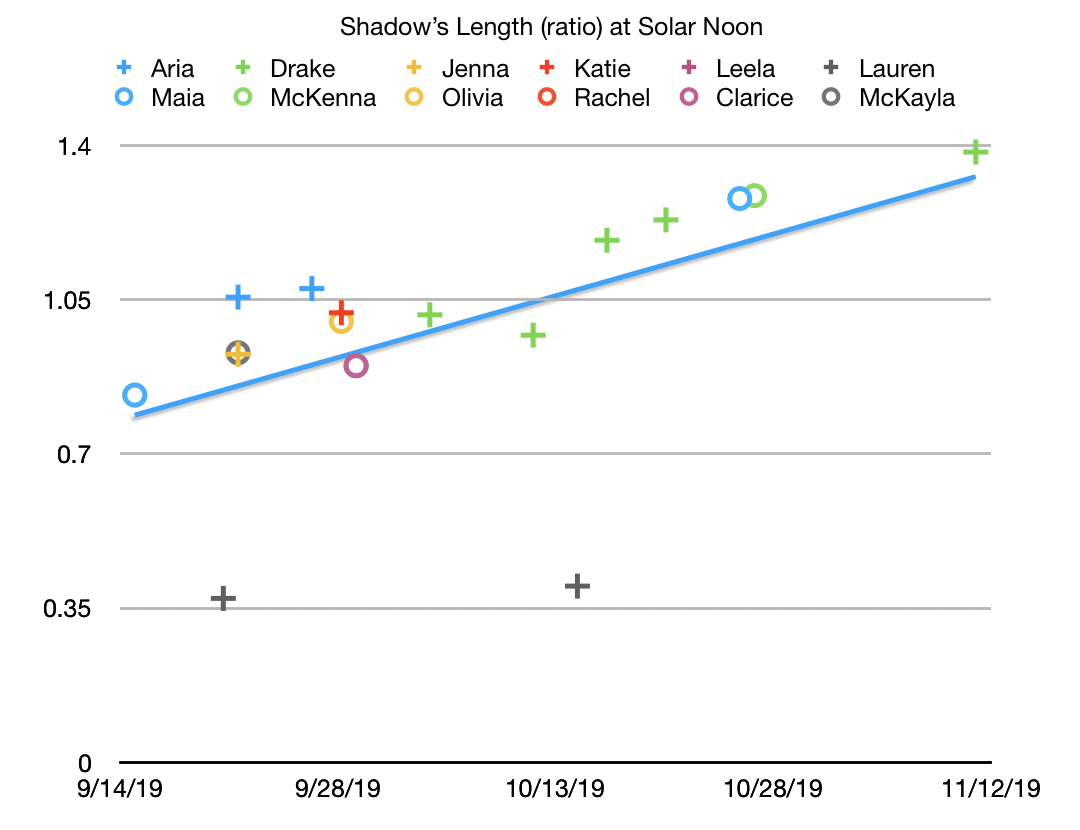
As shown in the graph below, the sun’s shadow at noon definitely got longer as we moved from the Autumnal Equinox on Sep 23 toward the Winter Solstice:
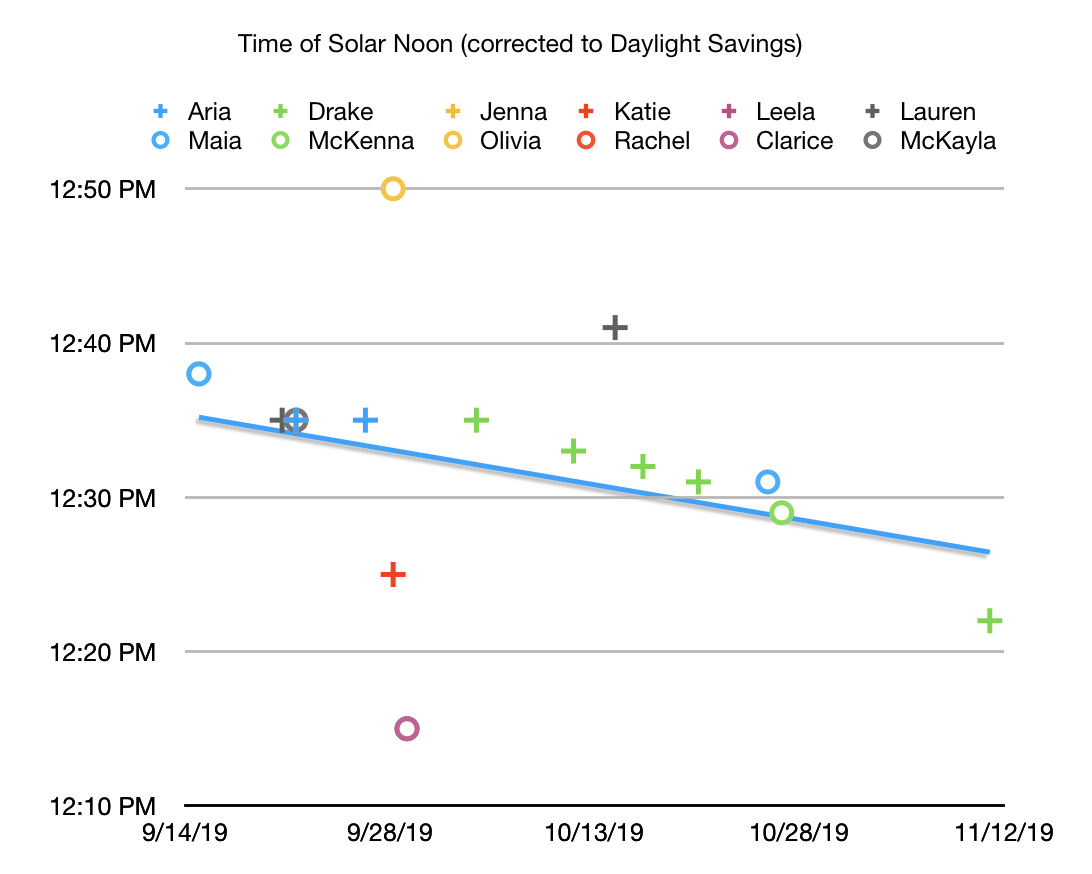
I was surprised to learn from your data that the time of solar noon shifted subtly over the course of the semester, moving from 12:35 to about 10 minutes earlier in the day by mid-November. At first I assumed that this was an error, but it turns out to be correct (link):
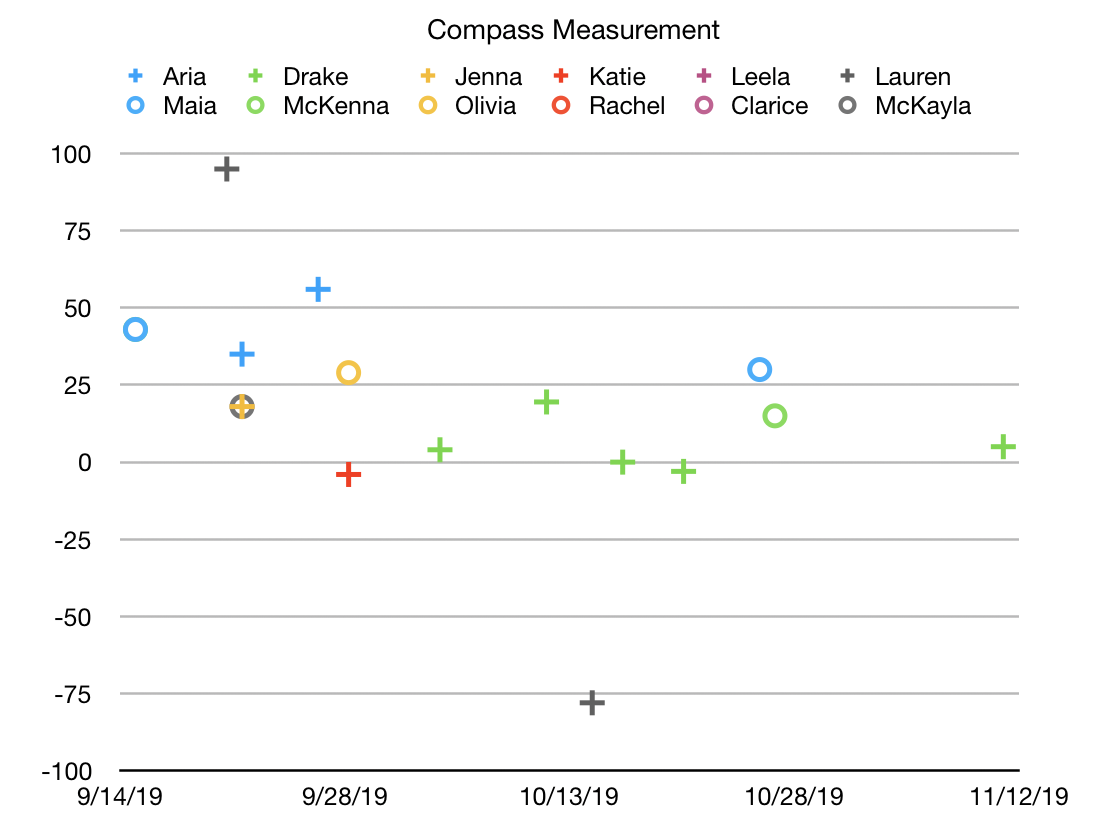
Compass measurements for the direction of the sun’s shadow were all over the map. They should be clustered around 14˚, but ours were as much as 90˚ off, essentially at a right angle to the correct answer. Given this range of error, I didn’t bother drawing a trend line:
Solar Noon

Determine the clock time corresponding to solar noon. This is trickier than you might think, and may require several tries before you get it right. I’m happy to give a week’s extension on this experiment, but do make a first stab at it during the second week of classes, so you have a sense of the challenges and can complete the project in time.

Full details in Fabian, Ex 2.1, “Gnomons and Shadow-Casting,” pp 33-34. You need to find a spot where the sun shines at noon and where the ground is level. An outdoor patio or bench is probably ideal: sidewalks and parking lots are often built on a grade, and the sun’s light may bend as it passes through glass to reach an indoor location.

Start by guesstimating the time of solar noon by looking up the time of sunrise and sunset in your location. Set up your apparatus 10 minutes before this time, and record the position of the gnomon’s tip at 1-minute intervals.

Apparatus:

  • Solar Noon radial graph paper, ruled in cm. Download and print.
  • A gnomon with a sharp tip—a sharpened pencil or the like. If possible, bring a range of possible gnomons, choosing one that casts neither too long nor too short a shadow—no longer than the ring marked 9 and no shorter than the ring marked 5 on the sheet.
  • Clay, gum, or scotch tape to anchor the gnomon at the center of the worksheet.
  • Scotch tape to anchor the worksheet.
  • A smartphone with a compass app.
  • If possible: a carpenter’s level. Otherwise, something rectangular to serve as a right angle tool.
  • A pencil to record your measurements.

Instructions:

  1. Find a surface with good sun exposure. If available, use the level to check that the surface is level. Otherwise, do your best to check it by eye. Flat concrete benches are likely level; sidewalks generally are not.
  2. Use the compass on your phone to align the paper so that the arrow at the top points due West. Anchor the worksheet to the surface with scotch tape.
  3. Anchor the gnomon at the center of the sheet, using the level or right angle tool to ensure it is vertical.
  4. Take a photograph of your experimental apparatus in action.
  5. Record measurements at 1-minute intervals, starting about 10 minutes before your guesstimate of solar noon, and finishing 10 minutes after. For each, mark an X on the worksheet at the tip of the gnomon’s shadow along with the clock time of the measurement.
  6. If you’ve done everything right, the gnomon’s shadow should get shorter, reach a minimum, then grow longer. The mark you made at the minimum represents Solar Noon.

Calculations:

  • Reading from the mark when the gnomon’s shadow was shortest, what clock time corresponded with Solar Noon? How many minutes is Clock Noon off from Solar Noon, positive or negative, in the city where you did the experiment (specify your city in your answer)? Would you need to travel East or West in your Time Zone to be in a place where Solar Noon coincides with Clock Noon?
  • Use a ruler to draw a line from the center of the worksheet to the mark corresponding to Solar Noon. That line is True North, by contrast to the 0° mark which corresponds to Compass North. Using a protractor, or estimating from the angle measures provided on the sheet, how many degrees does Compass North deviate from True North, positive or negative, in the city where you did the experiment?
  • Calculate the ratio between the length of the shadow at Solar Noon and the length of the physical gnomon you used. From this you can calculate the latitude of the city where you live. Tangent (Latitude) = Shadow / Gnomon. You’ll need a calculator with the inverse tangent function—make sure you get an answer in degrees (DEG), not radians (RAD).

Upload your results in a comment below, attaching your a photo or scan of the completed worksheet and (in a reply to your first comment), the photo you took of your experimental apparatus.

Marking Sunset-old

In a series of measurements over the course of the semester, determine (a) the clock time and (b) the magnetic compass bearing of sunset. Full details in Fabian, Ex 2.2, “Marking Sunrise and Sunset,” pp 34-35.

Post your fieldwork measurements via this Google Formvia this Google Form (link is now offline). Each entry should include a photograph of the sun against the horizon, the date of measurement, your physical latitude and longitude, and the two data points listed above.

Final Report

Use the Marking Sunset data (linked below) to reach an empirically driven conclusion about the timing and location of sunset in the fall of 2021. If you’re not sure what to focus on, think back to our earliest classes: “how did the time of sunset change?” is a good default research question, but it’s far from being the only one you might answer. It’s generally best to focus on how two variables relate to one another: date and time, date and compass bearing, time and latitude, etc., but you can give a more complex analysis if you’re feeling ambitious.

Note that this is a messy data set: in addition to possible measurement errors and typos during data entry, students took measurements in different locations (both latitude and longitude), and some had “true north” turned on while others had it off and still others “weren’t sure.” This means you’ll likely need to exclude some data or normalize the data set in the process of your analysis.

Your writeup should contain the following sections (aim for brevity, clarity, and specificity):

  • Goal: what phenomenon did you explore through analysis of this data set? What findings did you expect?
  • Procedure: what methods did you use in analyzing the data? If you excluded some data or normalized the data set, on what basis did you do so?
  • Results: your findings, including at least one visual representation of the data (i.e. a graph)
  • Conclusion: how did your findings differ from expectations? What does this suggest?

The Marking Sunset data is posted here. This link should give you view-only access. Please don’t ask me for edit access. Instead, go to the File menu visible within Google Sheets and either (1) make a copy so you can work with the data directly in Google Docs or (2) download to your laptop as an Excel file.

Email your results as a .pdf to Prof Henebry.